
3 years
3 years feels like 30. One by one, our "norms" have fallen and are being replaced by a whole new set of perspectives. Germany votes. A few thoughts on America and Ukraine.

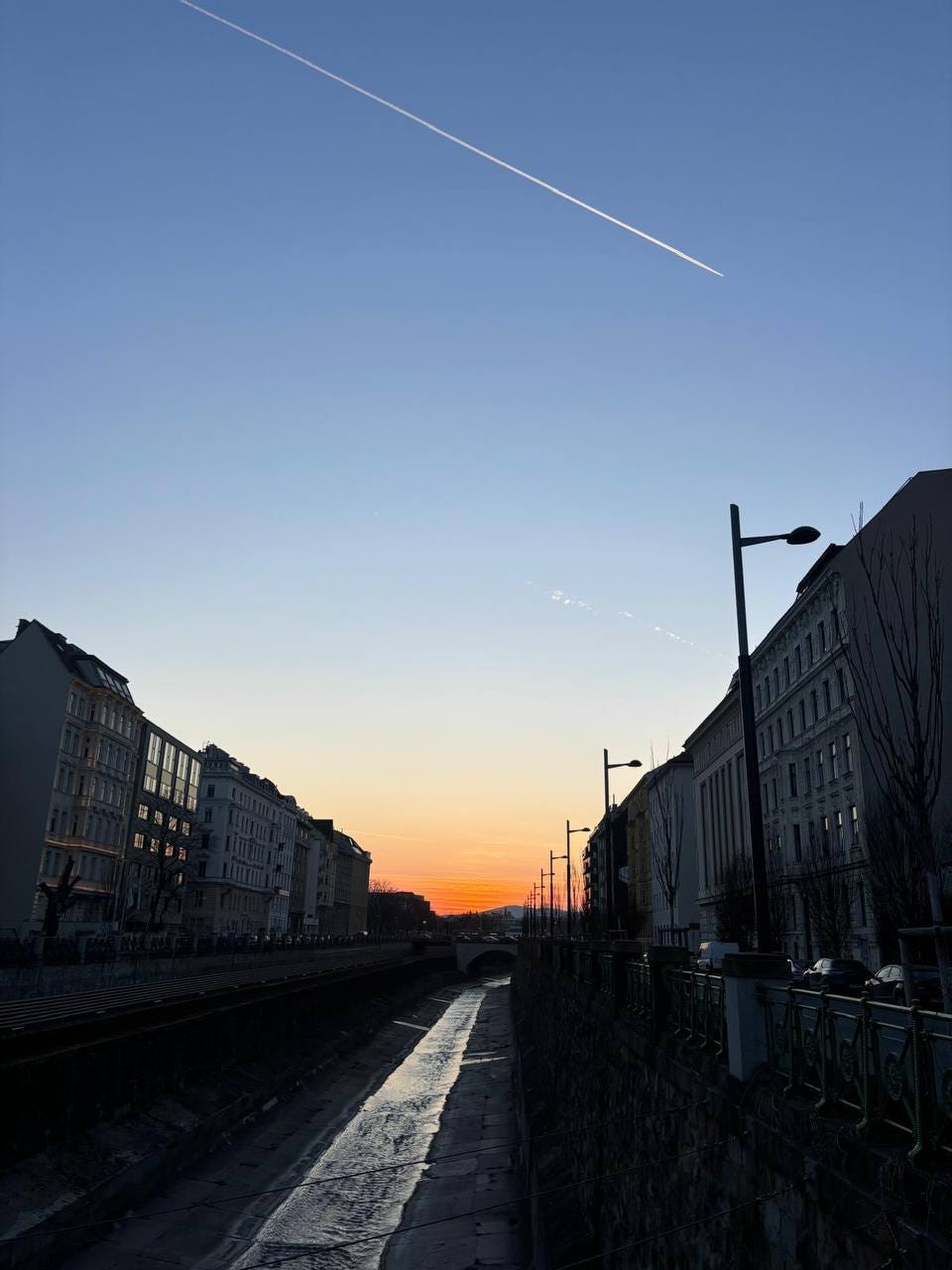
Today is cold, rainy and bleak. I fell asleep in the middle of the day which is something I rarely do. The only upside of me having literally slept away half the day is that I am now writing later, in time to share with you all the first results from the German election. Germany voted for a new government today, and there has been much apprehension about just how well the far right would do. The same far right who blased Musk’s creepy face all over video screens at a recent rally. The far right party which was, I learned this week, only founded in 2013 (not so long ago in political time). TL,DR: Germany looks actually, from a political perspective, less scary than Austria, but it is 10x the size. The conservatives won a solid first place, but 20% of Germans with an impressive 84% turnout voted for what many refer to as essentially a fascist party that would like to kick out all the immigrants, Make Germany Great Again, and basicly finally stop apologizing for the whole Hitler Nazi history. I exagerrate but not really. A useful long-read here if you are curious about this AFD and what it all means (interestingly written by the same journalist who wrote an entire book on Zelensky).
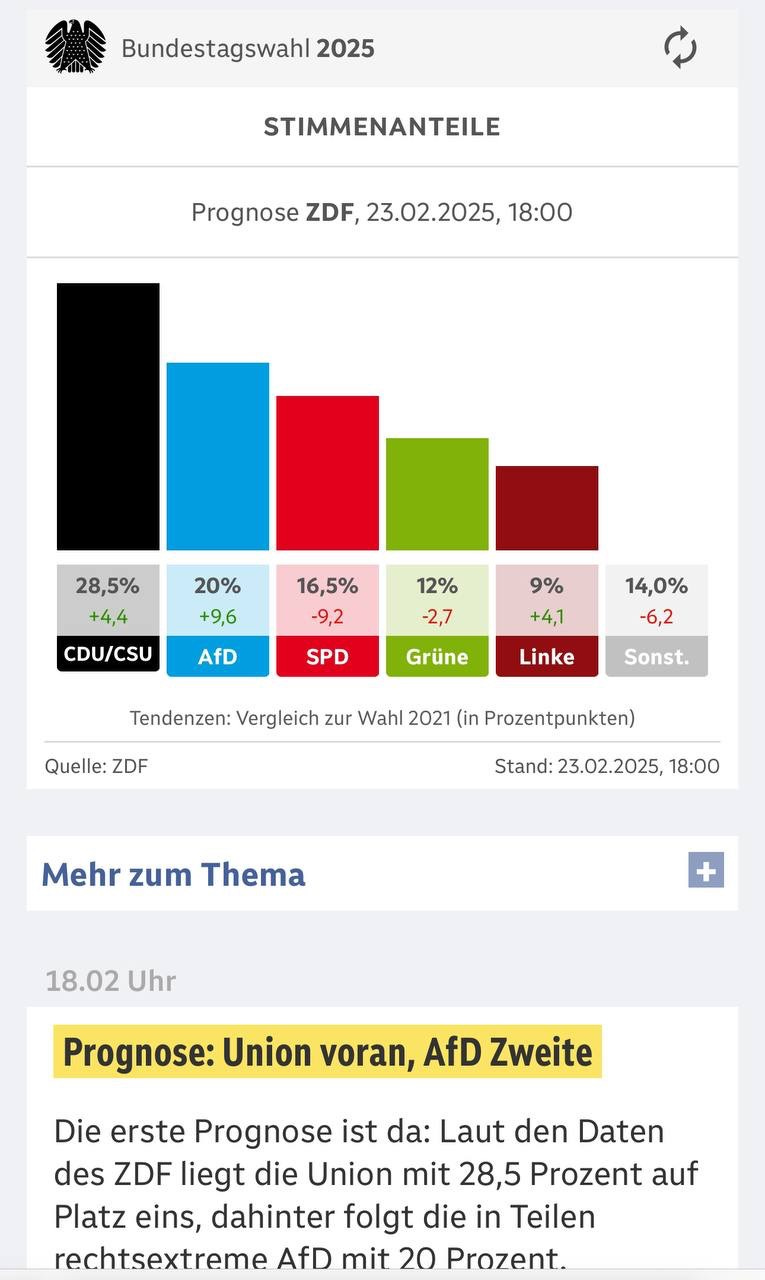
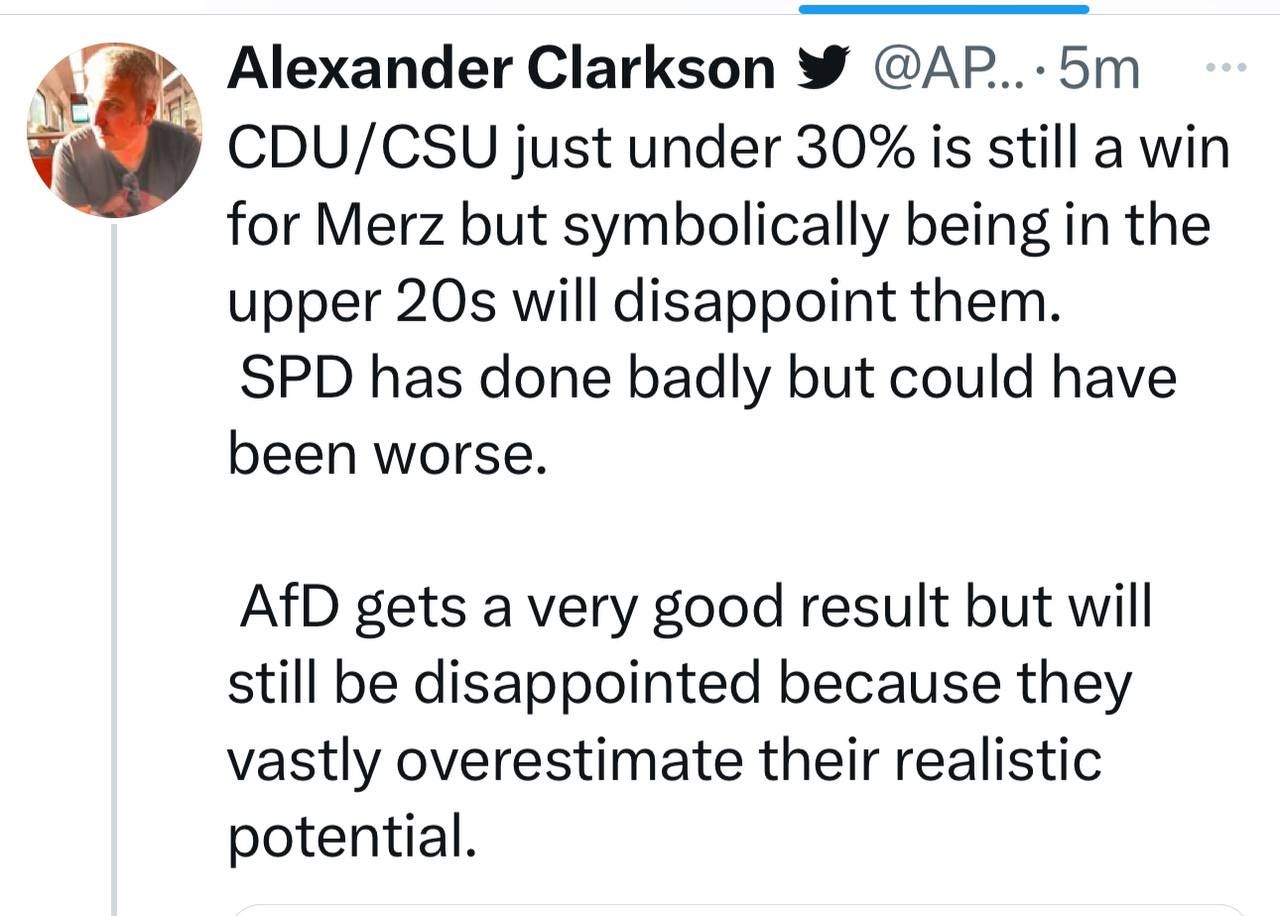
What these results mean is that Germany will definitely get a new chancellor, and a coalition will have to be built, as no single party received more than 50% of the vote. Just looking purely at the numbers, it seems the two options would be a three-way coalition between the conservatives, socialists, and a smaller third party, or for the conservatives to get in bed with the far right but even then they would still be shy of 50% so I assume (and I have not read a lot of analysis yet) the three-way coalition will be the result, with the far right in opposition. For now.
This is a great explainer by one of Germany’s most popular comedians about the rise of the far right party in his own country, in English, for the New York Times.
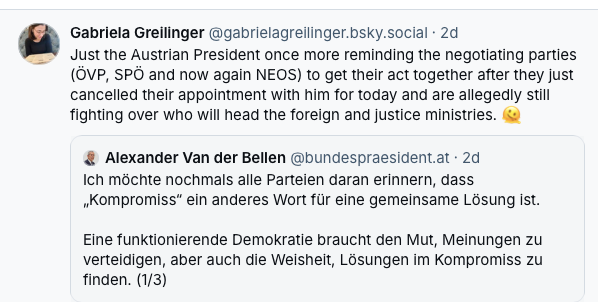
From the Austrian perspective, I think it is important to remember that here, in this little alpine nation, we took things a step further. Here the far right came in first place, we have lost six months to so far unsuccessful coalition buildling negotiations, first a failed three-way, then a failed two-way with the far right, and now the original parties who failed the first threesome talks have sat down, again. It is all maddening, somehow, how irrelevant it all is from a layman’s perspective. A bunch of extremely well-paid politicians (their salaries are amongst the highest in Austria, higher than many “ordinary” doctors and lawyers, on par with senior executives) have basically wasted the last half year with no tangible result. Meanwhile, actual real laws which impact ordinary people’s lives need to get voted on. And there is no leadership. Well, there is technical leadership, but not elected leadership. I am actually surprised Austrian voters have been so patient so far. I suspect they too are simply just disillusioned beyond belief. The machine keeps humming, but not for everyone, and certainly were there to be a sudden crisis, the leadership vacuum would be felt more acutely. The whole saga kind of reminds me how local politics at the absolute smallest level (think very small village mayor) can be both ruthlessly drama-filled and totally irrelevant. Whatever happens in Austria, it is unlikely (I say that with caution, remembering history, having walked past that infamous balcony today in the drizzling rain) to impact the course of Europe and the world more broadly.
In America, on the other hand, the Trump-Musk bros are ‘breaking things and moving fast’ on an epic scale. The stock markets got jittery — hard to tell if that was because of the freak show in the White House which they initially welcomed or because of some more cautious economic data emerging. There are a sea of tears and shock amongst federal workers suddenly laid off of ‘secure’ jobs they thought they would have for the foreseeable future. Musk appeared on stage clearly at the conservative CPAC high off his mind on something not for legal human consumption and waved around a chainsaw in sunglasses. Musk’s baby mamas are going after him on social media for alimony. The old school GOP silently rolls over in its collective grave.
One thing is clear. The message from America to the rest of the world is things have changed. There is a new way of doing things. We see things now from our perspective, and will lead accordingly. So far, that seems to be a turning back of all things designed to encourage diversity in hiring, employment, education, a return to whatever their heteronormative standards are — let’s hope they don’t expect the average Joe to run around having as many children as the narcissit, eugencist, billionaires who believe in having as many biological children as possible so as to make the world more populated with ‘smart people’ (I explained the Durov story to someone yesterday — the Russian founder of the Telegram app, probably the most popular social media/messenger app in the global Russian-speaking internet space).
I think it is too early to say with any certainty how Europe will react to all of this. It is clear that Moscow is loving this moment, but I don’t think they should grow too comfortable. Trump I think showed us during his first term how erratic he can be, and this time Musk seems to be calling many if not all the shots, and he clearly has a very short attention span. This week he reportedly threatened to cut Ukraine off from Starlink if they are not willing to sign the minerals deal the U.S. has shoved in front of Ukraine in exchange for continued military support. For a second it was hard to imagine that less than three years ago, it was Musk providing Ukraine with Starlink so as to maintain communciations on the front lines immediately after Russia’s invasion. I am thankful that back then in the spring of 2022, as the world watched in horror, none of us knew what things would have looked like in 2025. It would have been so demoralizing.
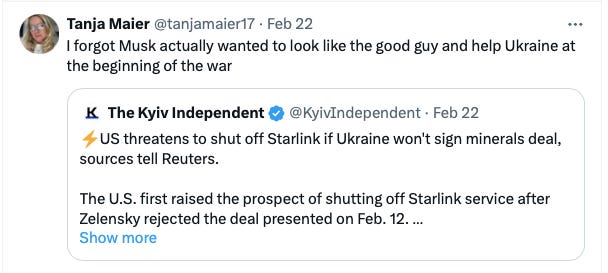
I have no insights on what is happening now inside Ukraine, but there certainly by now must be an understanding that they are facing a situation in which “great powers” for lack of a better word plan on deciding Ukraine’s fate without involving Ukraine. A situation I think, frankly, would have been terribly difficult if not impossible to imagine in 2022, but here we are. I was asked by a friend this week what I thought about Trump’s tantrum (here):
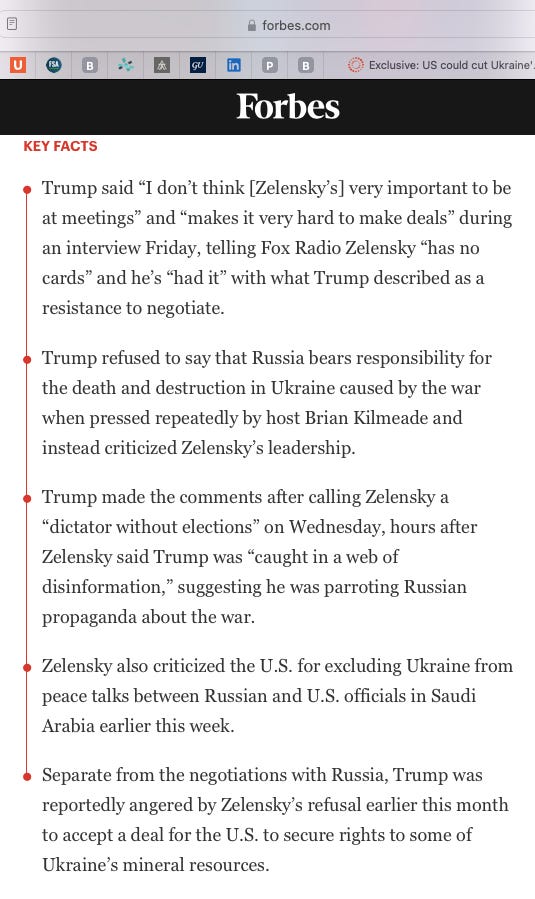
Yes, it is insane to call Zelensky a dictator and blame him for the war. Everyone, even the New York Post, understands who is the real dictator and who is really to blame for the hundreds of thousands of lives already lost since Russia invaded Ukraine three years ago tomorrow. However…and I am not both siding this, I am just trying to illustrate how things get taken out of context and twisted, especially by the political right. There is a grain of truth that a certain percentage of Ukrainians are upset with Zelensky, and are upset that there have been no elections since the war started. I would not dare to quote any kind of statistic, but I think it is a fair statement to say he is not a widely popular president anymore. Partially because of his entourage and who he surrounds himself with (many see him as being merely a puppet for his chief strategist, Yermak), and simply because the war has gone on for so long, at such a cost to society, and the price has been overwhelmingly paid by the ordinary Ukrainian families whose sons and fathers have given their lives. The flows of money into Ukraine from the U.S. have been enormous, and there are of course naturally questions as to where that money all went. Corruption on all levels of government was a problem before the war and it did not suddenly disappear because there was a war on. A Ukrainian told me this week, for example, the unofficial current cost of a “free pass” which is basically some kind of actual govenrment document allowing a Ukrainian man between the ages of 18-60 to leave Ukraine and re-enter on a regular basis, legally, is now $20,000 paid in cash if you know the right person. Inflation has taken its toll. At the beginning of the war, men reportedly paid $5000 on the border to get out. The economy is of course also suffering. It has been three long years. More civilian deaths than anyone could have ever imagined. While sitting at the negotiating table in Saudi Arabia, Russia continued to drop missiles on Ukrainian civilian targets.
I think the one word which everyone can collectively use to describe the mood for Ukrainians both those who left and those who stayed is exhaustion. Another woman told me this week about her ex-husband. Serving in the army. Still alive. Now has a massive drinking problem. Got sent to the front now. You understand where that ends, why it happened, and that he is not alone. He is an ordinary man from an ordinary-sized Ukrainian city where a man of his age does not walk around without expecting to be handed (this is phrasing it nicely) documents. I remembered this story because as she told it to me, my immediate thought was how many hundreds of thousands of stories just like hers there must be. How many kids are growing up without their dads. What will happen when the war ends and all the veterans come home, the impact this will have on society at large.
I do not dare make any predictions, but I hope Europe too, alongside Ukraine, now realizes the new world we are living in, and what this means. I was reminded also this week of the view from the other side of the Atlantic, when I was told a story about very senior executives at a very prestigious firm not really having any idea about the Munich security conference, Vance’s speech, and other things which anyone consuming the news on a regular basis in Europe knows. Europe remains, especially for the American 1%, the land of Mykonos, St Tropez, and Positano. Our anti-intellectual winner-take-all business culture in seems to survive all seasons of political change in DC.
I would like to close with this article, on the anniversary of a war which should never have started and I don’t think any of us at the time could have imagined would have gone on for this long at this cost to human lives. I hope for these kids, all the kids, but especially those living close to the front lines whose parents did not leave with them (something I also find very difficult to comprehend) that it will end sooner rather than later.

I think humans can get used to almost anything. I spoke this week with a couple who run their own business and live in a town only 100 kilometers from the front lines. They were so incredibly relaxed, they said “100” as if it were “1000”. They have accepted the new reality and adjusted to survive. As one does. As we all do. The one thing these past three years has taught me, perhaps more than anything else, is the strength of the human spirit to perservere and overcome even the most difficult circumstances. It has been a wake-up call like no other to be grateful for every single joy, big and small, life gives us, and to take the hiccups (and they come, often, fast and furious), as something we all have to deal with, to approach them with a deep breath and a sense of zen, of this too shall pass.
Maybe Austrians aren’t that impatient because the technical leadership does indeed keep the government machine running just fine for most people who can vote. It’s us non-citizen residents who need some solutions. Also Austrians are masters at non-commitment and not wanting to give a straight answer, so dickering around for 6 months getting a government in place is pretty on brand.
It’s true that a lot of the Ukrainian leadership, and a lot of the „elites“ are incredibly corrupt and have probably stolen millions. They’re not all heroes or even good guys. But it’s not as if Russia (or Trump) has any intention of bringing in clean government. The alternative is simply much worse. The EU should be fighting for the average Ukrainian to live their life mostly free of government or criminal interference, which you would think isn’t a huge ask. Just get Russia to go home. It’s funny how corrupt countries like Poland got much cleaner when Russian influence waned.
France in 1940 was not a model of good government- being a corrupt racist place that kept millions of Africans and Asians under brutal colonial rule. Yet it was clear to Americans that France didn’t deserve to be ruled by Nazi Germany, and we weren’t stupid enough back then to talk about Germany having a natural sphere of influence that we needed to respect.