
Closing the box
It has been more than two weeks since Trump and Israel opened Pandora's box, with the ripple effects already being felt around the globe. Now, it seems, no one knows how they will close it.

As I instinctively know very little about the war in Iran, and the Middle East more broadly, I find myself searching for information. I continue to be left with the impression that even the experts do not know how the U.S. can end what it has now started. Of course not clearly defining one’s goals makes it easier to declare victory and walk away, but the disruptions to our global economy even if the “war” were to end tomorrow are already staggering. It is as if the Department of War didn’t know what climate activists have been trying to tell us all for years: that we are all much more interdependent and tightly connected on this one planet with finite resources than national borders and languages and cultural differences would have us believe.
Why Little Was Done to Head of Oil’s Strait of Hormuz Problem (gift article NYT)
Yesterday, while scrolling TikTok, I came across this video from India where people are already fighting over a limited supply of natural gas which they need for cooking. That gas is of course normally coming in the form of LPG through the very Strait of Hormuz which America’s War Minister said was technically open except, as if a very small asterisk to his statement, Iran was still bombing it. Except that, yes, it is open.
An excellent map explainer by Bloomberg’s Javiar Blas here.
The ripple effects are actually truly global. And in just two short weeks. This video from Sky provides a very good overview of what the situation is like on the ground in the region right now. Dubai has reportedly told bloggers to stop filming their buildings being hit by drones. A few brave souls use written social media to describe what they are seeing and hearing. A Russian entrepreneurial company in Dubai is already selling “drone netting” for private homes, having quickly pivoted from hawking a special roof paint which promises to reduce your cooling costs in summer. Two of the largest airports in the world, Dubai and Abu Dhabi, are both not yet operating at anything near to full capacity. This has ripple effects on travellers around the world. These are entire economies based on a peaceful situatin in the Middle East. It is as if Trump and Netanyahu (let’s not forget who did all that lobbying) lit a match they had no idea how to blow out, and how far the fire might spread.
In terms of oil and gas, it is important to understand that it is not only supply that cannot get out, but when countries run out of storage, they have to turn off production, and that is not a process that you just turn off and on like a tap of water. There is pressure involved, and this is gradual process. So in layman’s terms, what this has done to the global market for oil and natural gas is a huge (expletive) deal and the impact will last for months to come, even if the war were to miraculously be over tomorrow. But it won’t be, of course, because America and Israel managed to kill part but not all of the ruling family, so now the son is in charge, and as much as Trump loves to make himself a “deal”, killing someone’s loved ones and then expecting them to sit down and negotiate with you is a script so ridiculous no Hollywood studio would ever bankroll it.
How big is the global energy supply shock from the Iran war? An overview from The Economist:
In this clip below, Carlyle’s Jeff Currie explains the disruptions to global supply chains and why this is not something that can go back to “normal” immediately. It is not just oil and gas, but fertilzers and other commodities. “The damage is going to take months to unwind. There is no policy response that can stop this ascent in crude.” So it is not just the price of oil, but the flow rate as he explains — the supply does not ramp up immediately after you turn off the taps.
It is almost as if there wasn’t an adult in the room who knew any of this 16 days ago. Israel might have known but probably didn’t care because it has it’s own view of things, rather in black and white, given its geography and history and the political situation the country’s leadership finds itself in. Forever war with neighbors is sort of the new normal now. But Trump’s American people, for whom he is supposedly doing all of this, did not need this. Their lives did not change one bit based on the regime in power in Iran.
So here we are. And no one seems to have a good explainer as to how this might end, quickly. And as the war in Ukraine has shown us, people can eventually get used to just about anything. Will we soon live on a planet in which half is at war and half is at peace and those of us lucky enough to live in peace simply reschedule our holidays accordingly?
I did not watch the Oscars last night but I did see the winners and was very pleased to see not only that Mr Nobody Against Putin won the Oscar for best documentary, but also that Sean Penn won an Oscar for best supporting actor for his role in One Battle After Another, but that he “ghosted” the Oscars and instead was on his way to Ukraine, which, to be fair, is a much more powerful message about the state of the world we live in than standing on a stage in a tuxedo to receive an award. This is the problem with peace and war co-existing. The rest of us want, understandably, to keep on living, while everyone living at war looks at us as if we have lost our minds, while they are out there quite literally trying to survive. You really cannot get your head around it.
While the world’s attention has been focused on the Strait of Hormuz, a place few of us could have named just a few weeks ago (myself included), Russia has taken the opportunity to continue to hit Ukrainian cities. In Moscow, the authorities have been jamming mobile phone internet and have turned off city Wi-Fi to the point that now you are basically without the internet on your phone in much of central Moscow, and it is starting to drive everyone crazy. Residents are actually having to call taxi companies to order cars. Maps don’t work. Many of the taxi drivers are immigrants themselves and have no idea how to drive through Moscow without navigation tools. The internet has been jammed because Moscow is being attacked by drones, and this of course, was never part of the Kremlin plan. So while we all talk about oil and gas in the deserts of the Arabian penninsula, and how to get it to the world, Russia and Ukraine continue their war, on the front lines, with drones, and in the skies.
Elsewhere, I am seeing more and more on social media from ordinary Russians wanting to finally leave Russia. There are messages even from big cities, like million + cities in Siberia, who have had enough of everything: the war, the cold, the snow, the lack of economic opportunity. They are ready to sell their apartments and go. Go to whereever they can. They write about small businesses shutting, the economic squeeze of Putin’s war affecting ordinary people. They do not see a future. You cannot blame it on the snow and cold alone because those were always facts of live in Russia. Now, ordinary Russians look around and say do I need this? They read messages from Russians who have left and emigrated far and wide. They know that immigration is not a panacea but they also know if they stay there is a very good chance that things will just continue to slowly deteriorate. The thing with the wild 1990s and fast moving early 2000s in Russia is that there was hope. There is no hope now, and this makes people move with their feet, as scary as it sounds.
I came across this BBC interview yesterday with Fiona Hill in which she argues that Putin essentially wants to make Ukraine another Belarus, which might have been believable back in 2022 before the war started, but makes no sense now after more than four years of bombing and killing ordinary Ukrainians, how exactly would you imagine a peaceful vassal neighbor after you spent the past several years trying to ruin their homes and their country? A friend told me yesterday about a scenario which she heard whispered by an ordinary Ukrainian now living in Europe and actually, frankly, that scenario sounds more plausible to me. The east of Ukraine is already lost to Russia. Those living in occupied territories have already had to accept Russian citizenship to have mobile phones, banking, collect pensions, and even see a doctor. So those regions are gone. The middle of the country, the theory goes, remains as some kind of weakened, decapitated Ukraine. And the far west, the regions closer to the EU, they get absorbed by neighboring countries like Poland and Hungary, and the EU essentially expands its own borders. It does sound a little far fetched, yes, but it also reflects the mentalities on the ground. The one thing both of these prognoses have in common is there is no scenario in which a strong and free Ukraine emerges. Which is perhaps a lesson for future generations about what half-way support results in: half-way results.
This week I also wanted to recommend a very, very long read (11 chapters, and I am yet to read it in full myself) about Russian spies and hired Balkan killers and how they got caught using Google translate to communicate between two Slavic languages which often sound similar but can at times mean two different things. Once again, Christo Grozev and team have completed a masterfull storytelling from the very real world of Russian spies and hired killers:
Lost in translation: How Russia’s new elite hit squad was compromised by an idiotic lapse in tradecraft
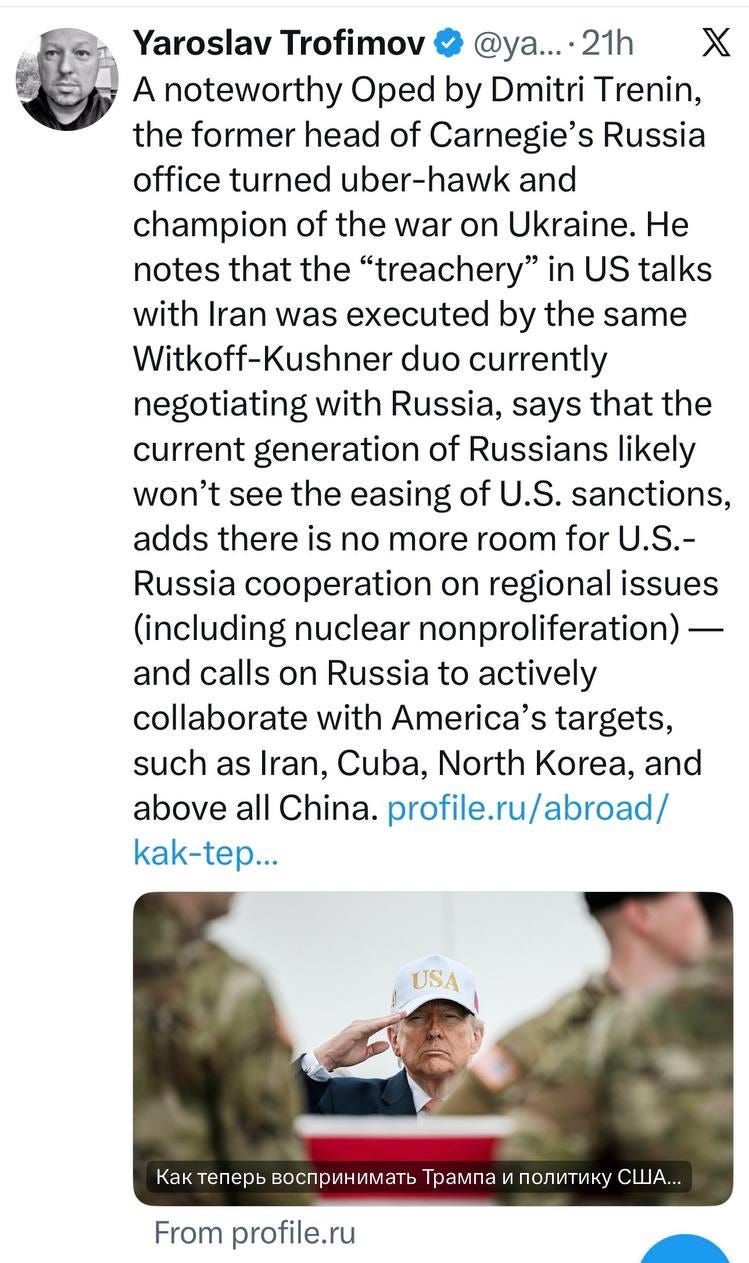
In thinking about a world in which we co-exist alongside several major wars, all hoping they won’t reach our borders (head in the sand sort of attitude, with a hope and a prayer), I think it is also important to point out this written by one of Russia’s public intellectuals, Dmitry Trenin, who was once western-leaning and in recent years turned very pro-Kremlin. It is important what he is saying, namely, that Russia has no desire to become friends again with the U.S., that it will fully support other rogue states, and cosy up as much as possible to China. The lines appear to be drawn and no teams of negitators no matter how close they may be to Trump and Trump’s own inflated views of his own “dealmaking” skills are really no match for a new world in which countries have real enemies and the stick is more powerful than words. A violent playground, indeed. And the rest of us have to just get on with our lives and try to take cover when things get hot. What a sad state of affairs. How lucky we were to live in peace, and how little we appreciated it at the time.
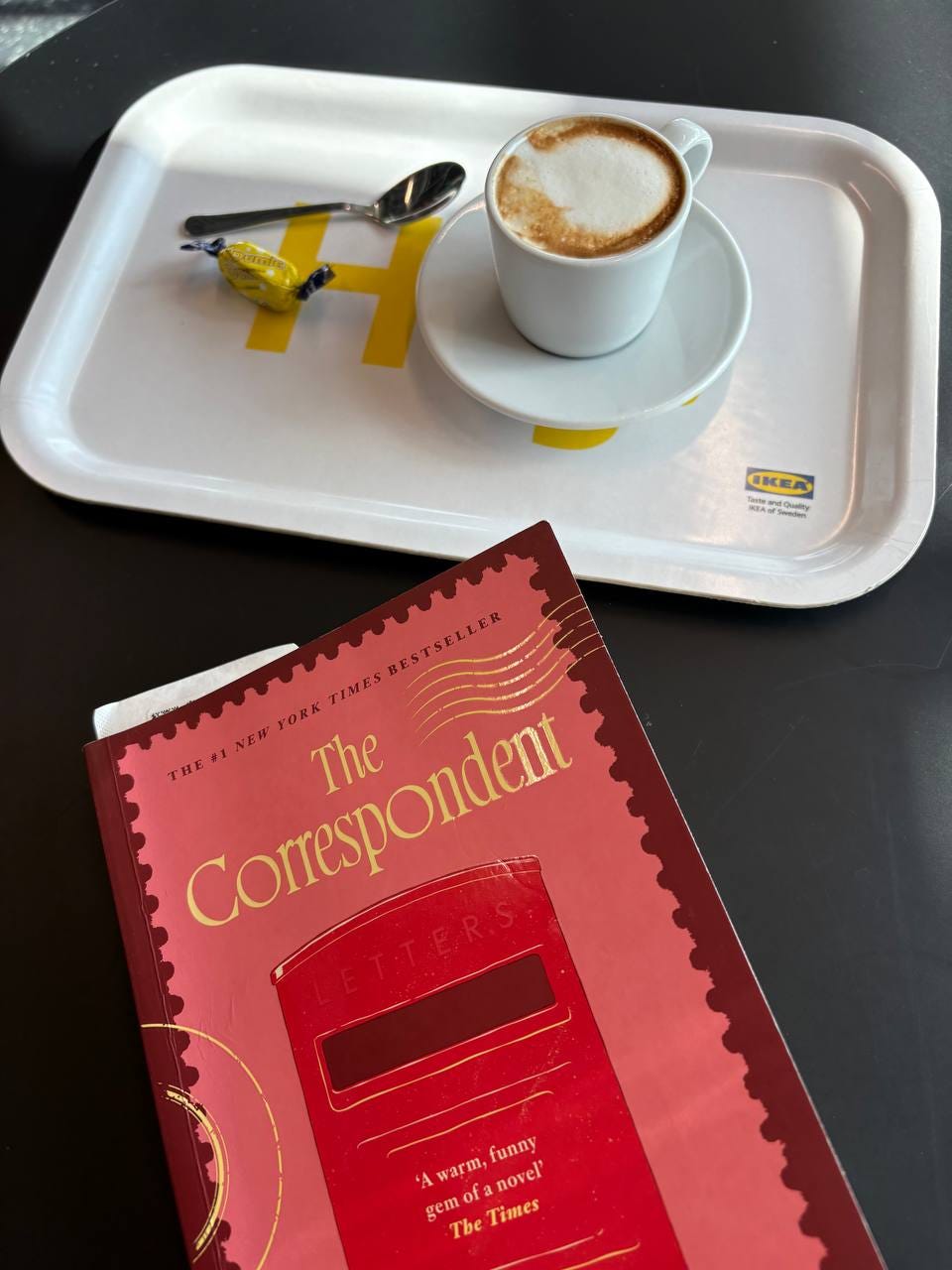
This week I also read The Correspondent, which is a remarkable book because I absolutely loathed the main character, and yet found myself drawn into the story, wanting to know what would happen. It is written entirely in letters and emails, and has become something of a slow-burn hit, being recommended through word of mouth to reach bestseller status. The writing is divine. A real talent. I don’t know how you sit with a main character that unlikable to produce such a work of art.
I think that is it for me this morning. If you are struggling to make sense of all of this, you are not alone. I find myself more focused on little things in my own life, a distraction of sorts, perhaps not unlike how many of us started weird little hobbies during covid. We cannot control what is happening around us but we can control what is for dinner, that sort of thing.