
Contradictions
Apologizes for my absense. Writers block induced, to be honest. Some weeks I simply don't feel like I have anything meaningful to add to the public discourse.


I suppose it was sometime back in 2022 or 2023, in the thick of my volunteer work, that I decided writing weekly here would be a maintainable goal. And for the most part, I have managed to stick with it. But last week, and continuining into this week, I have felt this overwhelming weight on my shoulders, like I need to say something, anything, insightful, and yet I feel like the best I can do at the moment is restate other people’s observations and ideas. I am also dealing with some health stuff that while not serious (thankfully) makes me completely exhausted for no reason, so I will try to keep this short and focus on the ideas that lingered in my brain these past few weeks, in no particular order. They share one thing in common, namely, that nothing makes sense anymore. That two things can be true at the same time and yet on paper, if you line them up, they seem to cancel each other out. Wars are generally economically and humanly distructive and not good for any country engaging in them and yet they continue, with no real end in sight. The state of the world economy at the moment means that nearly every ordinary person is feeling the pinch in their wallets in a real and meaningful way, yet there are plenty of opportunities to make a quick buck if you are the right combination of smart and lucky and have some starting capital and access to markets. AI is changing our lives faster than any of us could have imagined even a year ago, and yet politicians around the world appear woefully unprepared to present any kind of solutions for the ways in which it is about to upend what it means to be economically productive on an individual level. I am frankly, truly surprised there are not more calls for universal basic income, but more on that in a second.


Let me begin by suggesting two new non-fiction books, both of which I could not put down. Excellent writing, timely, insightful, emotional. Both of these books had me walking from the subway home book open, reading glasses on, nearly bumping into strangers. They are both that good. After a long slump in which I could not really motivate myself to read anything that wasnt on a screen, this was a thoroughly delightful discovery. My middle child is watching old episodes of GIRLS, a new generation is discovering Lena’s gift for writing. Nature is healing, etc.
Yesterday was perhaps the most depressing 9th of May in recent Russian memory. I was actually pretty shocked a few days ago when I saw photos of drone netting over Red Square (a quick AI-aided search now confirmed for me those photos were in fact fake and shared by a Ukrainian advisor to the defense minister). But the sentiment they represented is very real. The parade was so scaled back it included North Korean soldiers marching in place of Russian heavy equipment. I still cannot get my head around how in the middle of a four-years-and-counting war against the very country you then fought side by side together with as one to defeat Nazi Germany, Russia can even find anything to celebrate. The whole fiasco looks as stale as Putin’s regime, which I dare say, seems to be aging these days more like spoiled milk than fine wine. It feels like stagnation has morphed into something worse, darker, and bad news has a way of picking up speed like a snowball rolling down a mountain.
I recommend this excellent summary of the weekend:
I was at dinner with a Ukrainian friend on Friday evening when she pulled out her phone and showed me the news of Zelensky’s official presidential order ensuring Ukraine would not target Red Square on May 9, purportedly after Trump had intervened to call in this favor. My friend was incensed, particularly as Russia continues to target and kill Ukrainian citizens every day. The Ukrainian media spun this as Zelensky “trolling” Putin, but honestly, is any of it even funny anymore?
What I hadn’t realized until I took a closer look this week (this podcast takes a deeper dive for anyone interested) was exactly how much damage Ukraine has been able to inflict in recent months and especially weeks on economic targets across Russia. The Bell published this week this map:
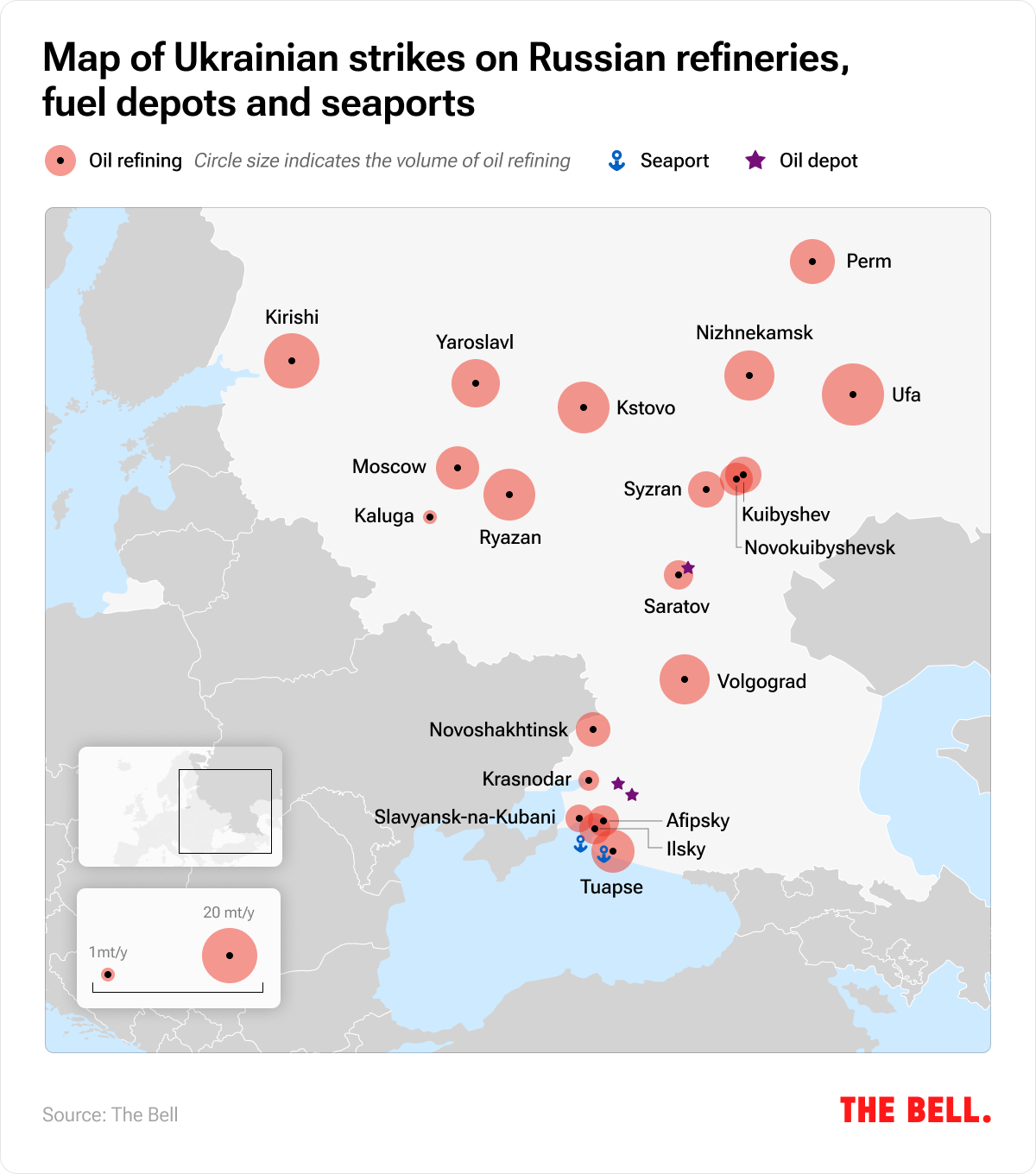
So Russians are not only dealing with permanent bans on all foreign-made messenger apps, regular cuts to mobile internet in cities like Moscow and St Petersburg, an economic crisis showing no signs of abating, with many small businesses forced to shut their doors, but now the violence of war has come home, and major Russian companies are having their assts directly targeted and damaged. Who is going to pay for all of this and still sell it as a win? It is no surprise the old man is choosing to spend as much of his time in isolation as is possible these days. There is no strategy. There are no wins to be had. It feels like the house of cards might just be starting to wobble. Maybe.
A friend recalled a recent conversation with a well-off woman who returned to Moscow to check on her assets (as one does), and for the first time there was a hint of it is no longer a city where I would like to live right now, citing inconveniences such as having to switch on a VPN to send a message using one of our communication apps, or not being able to order a taxi when the internet it down. These little things grate on you when suddenly your ordinary life, the implicit contract that was Putin’s promise to the “elite”: you get to make money and live a comfortable life, provided you stay out of my politics, are no longer true. Russians regularly remember the “good old days” when you could fly to Paris or Rome for a weekend on a regular salary, and Schengen visas were not as elusive as tickets to a sold-out concert. Of course if you ask Ukrainians how they feel after four plus years of all-out war and not an airport being operational across the entire country, there will be no sympathy, but the key to any kind of lasting change in Russia is general discontent amongst most of the population, although I would not hold my breath in anticipation of a revolution. There will not be any. But a coup? Honestly, who knows. It kind of feels like anything is possible. The messaging and the tactics look stale, as if the collective “Kremlin” have run out of tricks up their sleeve.
This week, The Economist published a piece by an anonymous former senior Russian official entitled Vladimir Putin Is Losing His Grip On Russia. Too good to be true? Maybe. But the cracks are showing.
CNN on small businesses in Russia closing. I read every day on social media about Russians from cities across the country planning how to emigrate. Economic frustration drives these decisions as much if not more than anti-war sentiment. Anti-war folks left in 2022. Those leaving now are doing so because they no longer see a future in Russia.
This video describes a new European intelligence report describing Putin’s increasing isolation and fear of an assassination:
Huge caveat. Observers far more informed and with better sources than me think the exact opposite, that Russia isn’t on the brink of anything. Do read Farida if you don’t already:

Meanwhile, in Ukraine, I have heard stories recently about businesses having to close, not able to survive in a war economy in which everyone is feeling poorer, those men still living in Ukraine of army age are increasingly isolated at home, fearful of being handed draft papers while out in public. This means if you own a restaurant, for example, your business was already struggling. Now the women are spending less money, ordering only a drink but not food. Eventually, you cannot cover your fixed costs, and you make the difficult decision to shut your doors.
Another person tells me the story of a young man who had enough and ran away from the army, now sitting in the countryside in his parents’ home. But being hidden away is not a life for a young man in his late 20s, so the family are now thinking about how he can return to the army, just in a way that doesn’t mean automatically being sent to the front.
I read a report this week about a Ukraine government order requiring families on the front lines to now hand over their children for mandatory evacuation.
Here in Austria, I have noticed something which is hard to put my finger on, but I mention it in my private conversations. I feel like many Ukrainians are really suffering now in a psychological sense. The war has dragged on for so long, they are no longer new arrivals, are expected to be fully self-sufficient, and yet, more often than not, things have gone wrong along the way, buildling a new life in Europe has been anything but easy. A woman wrote me last week from somewhere in middle Austria explaining her husband had died with 42 (here, circumstances not explained), and how should she and her son now pay rent, cover funeral costs, survive? I of course don’t have answers to those questions. I made some generic suggestions and offered my condolences, reminding myself, for the sake of my own mental health, that I cannot help every person who contacts me simply because they knew how to contact me. I have recently sat through very painful discussions at schools and hospitals where teacher or doctors say X and the Ukrainian hears Y and only Y and it is like no one is listening to each other. As if everything is a fight and you no longer trust anyone. Perhaps high cortisol for extended periods of time can do that. Anyone can be strong for two weeks or even two months. But four and a half years? Frankly, I suppose I should wonder why I didn’t see it earlier.
The happy ending we all hoped for appears to be the thing of fairy tales.
The final topic I would like to cover ever so briefly is the general cost of living crisis. Ask anyone, in any western country, and they will talk to you about the cost of food, gas, airplane tickets, basically anything. It feels like everything got more expensive and no one is earning any more than they did before, at least on salaries or hourly wages. This podcast talks about recent American political polling but it is insightful:
In the same breath, we have AI changing things at lightening speed, and AI-adjacent stocks are going crazy. I made a few adjustments to my own portfolio in April. They were hardly researched. I did a quick Google search (pardon me, Gemini!), wrote down a list of names recommended by famous Wall St banks, played a game of "Eeny, meeny, miny, moe" with the tickers, and by some miracle of momtentum and TikTok traders, one of those names is up over 50% since the end of April. It makes absolutely no logical sense that passive income can significantly outearn normal wages even with modest starting capital with such swings in valuation. Of course, this also means the bubble can burst at any moment, and you can lose as much passive income just as quickly as you make it. But in general, this AI thing, it is here to stay, we are all using it in our daily lives, and politicians in general have been totally head in the sand ostriches when it comes to talking about how they plan to provide universal basic income or address the question of “man searching for meaning” or at least how to pay his/her bills in an era when many, many white collar workers will suddenly be totally redundant.
I came across this New York Times’ TikTok today on the AI boom and its potential impact on jobs…
…and earlier last week about the impact of data centers on U.S. communities, and how that may affect the midterm elections:
I was recently in Austria’s equivalent of the job center or unemployment office, which is also tasked with assigning recent immigrants free German language courses. The politics of the organization are such that their employees are instructed to never speak English even if they know it and the “client” is a recent immigrant whose English is better than their German. For this reason, I was accompanying a Ukrainian woman who used to own and operate her own hotel, and now wanted to be assigned a German language course. She had been turned away, twice, when she tried to speak English, and we were ushered together intoa tiny office decorated with sun-damaged prints from China and filled with plants surrounded by plastic water bottles half-filled with water positioned next to a humidity monitor, as a beaurocrat worked his way through her CV with a pace which mirrored that of the DMV sloth in Zootoopia. Here was a person who was performing his job, objectively speaking, terribly, with no incentive to hurry up, asking totally irrelevant questions for the sake of watching the clock go by until it was time for lunch, much slower than any AI could have done, prone to human error, with a sense of importance that made him triple-check how he placed a staple or pull out a yellow highlighter and highlight dates and times that were already printed (because nothing has gone paperless, Austria is like a heroin addict when it comes to the printed word) in bold all caps.
We need a solution for when AI takes all these, objectively speaking, “busy work” jobs in one fell swoop, which could theoretically happen anytime. These “sloths” are people who need a purpose, need an income, and that is going to be one hell of a challenge. Not that I feel particularly sorry for them. I don’t. And everyone with an entrepreneurial streak is going to be just fine. But many governments (looking at you, German-speaking Europe) actively legislate so as to prevent entrepreneurship, and then will be stunned when suddenly they need to provide some kind of basic income, and more importantly, purpose in society to a whole generation of paper pushers used to working in government and government-adjacent offices.
It is really crazy if you stop to think about it. The video above says that companies like Meta laid off 10% of their workforce using AI as a cover for what was really just cost-cutting, but it is a warning sign nonetheless. There will be no bidding wars for jobs computers can do better. I heard someone recently refer to their entrepreneurial spouse as the ultimate “idea generator” and perhaps those people will be just fine. But we are all going to need to change our outlook on work and value creation. All of us who do not work with our hands to create something a computer cannot replicate.
On the one hand, you could in theory feel even more sorry for recent graduates. But they at least have a chance to start off doing something entirely new. We just lack the vocabulary to give the right guidance now as everything is in flux. But the real challenge will be everyone 30+ who feels the rugs suddenly pulled out from under them. The five stages of grief will be painful and may not pass quickly. I see nothing from politicians in any western country to indicate they are planning for this in any real way, with any sense of urgency, which is downright alarming given the speed with which our lives might change. An invisible storm on the horizon.
So these are the thoughts which keep me up at night in no particular order: war, economics, AI.
That is all I have in me this week. Perhaps I will try now to write not just on weekends, but simply when I feel the inspiration. Thanks for your patience, and as always, for reading. My summer book pile is quite thick now with what I hope are fascinating new titles, and I hope to share some more with you next ime.
Did I understand this correctly: someone asking to be assigned to a German language course is expected to ask in German?