
Elena
The third in a new series of interviews with Ukrainians who have now established themselves and built new lives in Austria.

Elena reached out to me over Instagram and told me she would be happy to share her “positive” story about moving to Austria from Ukraine. We met in a traditional Viennese cafe in the city center, and as soon as Elena started talking my mouth dropped, as I hadn’t known what to expect — a professor of German language was not on my bingo card!
Elena is from Odesa and came to Austria with her son who was six when they left (he is now nine) and her mother. In Odesa, she worked at the university as a professor of German language and literature. They spent the first few days of the war at home, scared, sleeping in their clothes, understanding that they might have to leave in the night. When they decided to leave Ukraine, they did what many did — they first went to Chișinău, in Moldova, thinking it “might all be over in a few weeks”. When Elena realized the war would not be over that fast, she began to consider her options.
Elena explained to me there are international conferences which take place every four years which bring together German professors from around the world. At one such conference, she had met a professor from the University of Vienna, and they had loosely stayed in touch. Elena received a message from the Austrian professor, inviting her to coming to Vienna, explaining she knew of an empty studio apartment the family could stay in for a few weeks. At the time, Elena still thought it would be temporary, but her Austrian colleague assured her they could stay longer if they needed it. The way Elena tells the story, the Austrians realized the war would not be over quickly before many Ukrainians came to this grim realization.
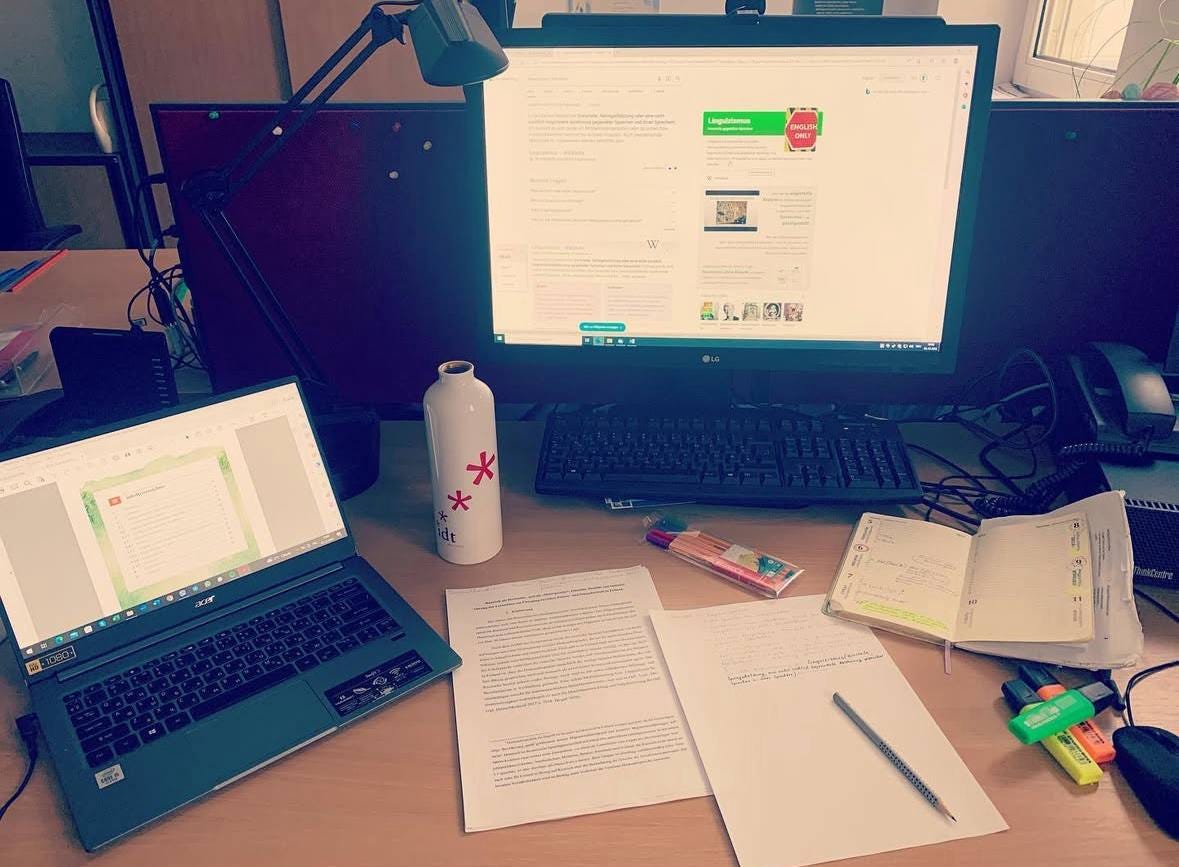
The University of Vienna established a special program for Ukrainian academics providing them with a table and a computer: a quiet workspace. You see the set up in the photo above. This space allowed Elena to keep teaching her Ukrainian students online, as they had left in the middle of the semester.
Elena was then invited by the university to conduct a special research project, on a volunteer basis, but in her field. Unpaid, but it accomplished two things: it gave Elena something cerebral to focus on and take her mind off all her other worries, and it also allowed Elena to show her colleagues at the university the kind of work she was capable of. The project was aimed at school children, who were presented with sets of drawings of “scenes”, and they were asked to describe each scene in their native tongue (in the case of Ukrainian kids — this could be Ukrainian or Russian, whichever language they chose for themselves) and then in German. Elena refers to this time period as “work therapy” meaning the project helped her personally. It was a welcome distraction. 48 children took part in the study. Elena beams when she talks about the work; you can see how proud she is of what she achieved and how exciting it was for her to be conducting an academic project in a new university with new colleagues.
Elena’s colleagues at the university told her about a postdoc position which she could apply for, submitting her work experience as a volunteer on the research project as evidence of her qualifications, in addition of course to her experience in Ukraine. Elena was accepted to the postdoc in October 2022 — less than one year after arriving in Austria. She continues to work on similar research projects. She has a contract to work twenty hours per week, which she says is fine for the moment.
Elena is focused on the topic of multilingualism, or as they say in German: Mehrsprachigkeit. She is looking into all the nuances of this in children. For example, many Ukrainian children experienced speaking Russian at home, first attending school in Ukrainian, and then moving to Europe and beginning school in a third European language.
I ask Elena about her own son. He attended a local primary school which happens to have a lot of children from Hungary, so he has also picked up a few words of Hungarian.
It sounds to me as if this concept of multilingualism is only now starting to be seen by educators, particularly at the school level, as a benefit rather than a hindrance. In her work, Elena is now working with schools on designing their “mother tongue” lessons, for example in Ukrainian for children from Ukraine. To my knowledge this is not something widely available in schools — yet. Of course work has already been done by her colleagues on the other languages found in Viennese classrooms: Turkish, Arabic, Bosnian/Croatian/Serbian. She refers to it as “BKS”, the abbreviation used in Austria for the language spoken across much of the former Yugoslavia.
I ask Elena how she finds Austrians in general. She remarks they are a bit reserved, but as she herself is a calm person (this is true, she is very much an academic sitting across from you, which was a change for me as I am used to speaking with Ukrainians from all walks of life, rarely with PhDs). She feels comfortable here. Yes, she admits, sometimes people are a bit colder than back home.
I ask if she ever travels back to Ukraine. Not really, she explains. Her mother sometimes goes to “see her doctors”. You hear this quite often from the elderly. We talk about life in Odesa now. How life goes on, despite the dangers. How human beings eventually can get used to nearly everything. She tells me about the sounds of the drones incoming, how kids are expected to go to school the next day with little sleep if they were woken up to go to the shelter, the sirens at night. I am left with the sense that people in Elena’s home city are living under an additional layer of stress that has now become the new norm but it is not normal, and that takes its toll after months that turned into years.
I ask about Elena’s mother. She has found a group of Ukrainians aged 60+, and has taken some day trips with them. She is happy socially. Elena’s son will start gymnasium in the fall. He has earned good enough grades to be accepted. I ask Elena if she taught her son German back in Ukraine. “No,” she looks down for a second, “he didn’t know any German before we came.” Like many other Ukrainian kids, he finds math and social studies in Austrian school easier than back home. He has continued Ukrainian school in the sense that he is sent assignments and then has to hand everything in at the end of the semesters. He usually has to do work for Ukrainian school every evening, Elena explains, in addition to his Austrian homework. She has found an online tutor for him for the Ukrainian language.
I ask Elena if Vienna feels already like home, and she says it does. She sings the praises of Wienxtra, which provides a whole range of either free or very affordable activities for kids in Vienna during the school holidays. Her son has done so much with them — from bowling trips to field trips to see how the city is supplied with water and electricity.
I change the subject and ask Elena if she already received an RWR+ residency card, which she has, for three years. She explains that one can hold a postdoc position at Uni Wien for a maximum of eight years. Her first contract is for four yers, and she will have to reapply. I suppose this is designed to “protect” tenure track positions.
We talk about how children grow up in Austria, how they mature quickly here, and are given a lot of independence at an early age, which is true.
Elena shares with me more from her academic work, a concept called “code switching” about how children express themselves in different languages. She talks about how her research project was eye-opening for many teachers, who could see for the first time how well children could express themselves in their native language. Which is a really good point. Sometimes classroom teachers cannot see the “full” child if they are only trying to communicate in German.
At the end of our conversation, I ask Elena the question I should have asked at the beginning: why German? She explains, without going into detail, that she grew up living in different countries (during the Soviet period), and part of her childhood was spent in Germany. I nod in understanding, having learned by now not to pry when someone doesn’t want to elaborate further.
Elena’s story is unique in that unlike 99% of her fellow Ukrainians, she didn’t arrive to a language barrier in a new country. But she still had to adjust to a new life, in a new city, away from her husband, who remains in Odesa. She is now proudly working at a European university, something she probably never envisioned for herself before the war. So there are silver linings. Sometimes. For the lucky and determined ones. Because it is not all luck. It is also a lot of hard work.
Thank you so much! Was very happy to read this. Seems Networking kann help to survive 😊