
Frozen
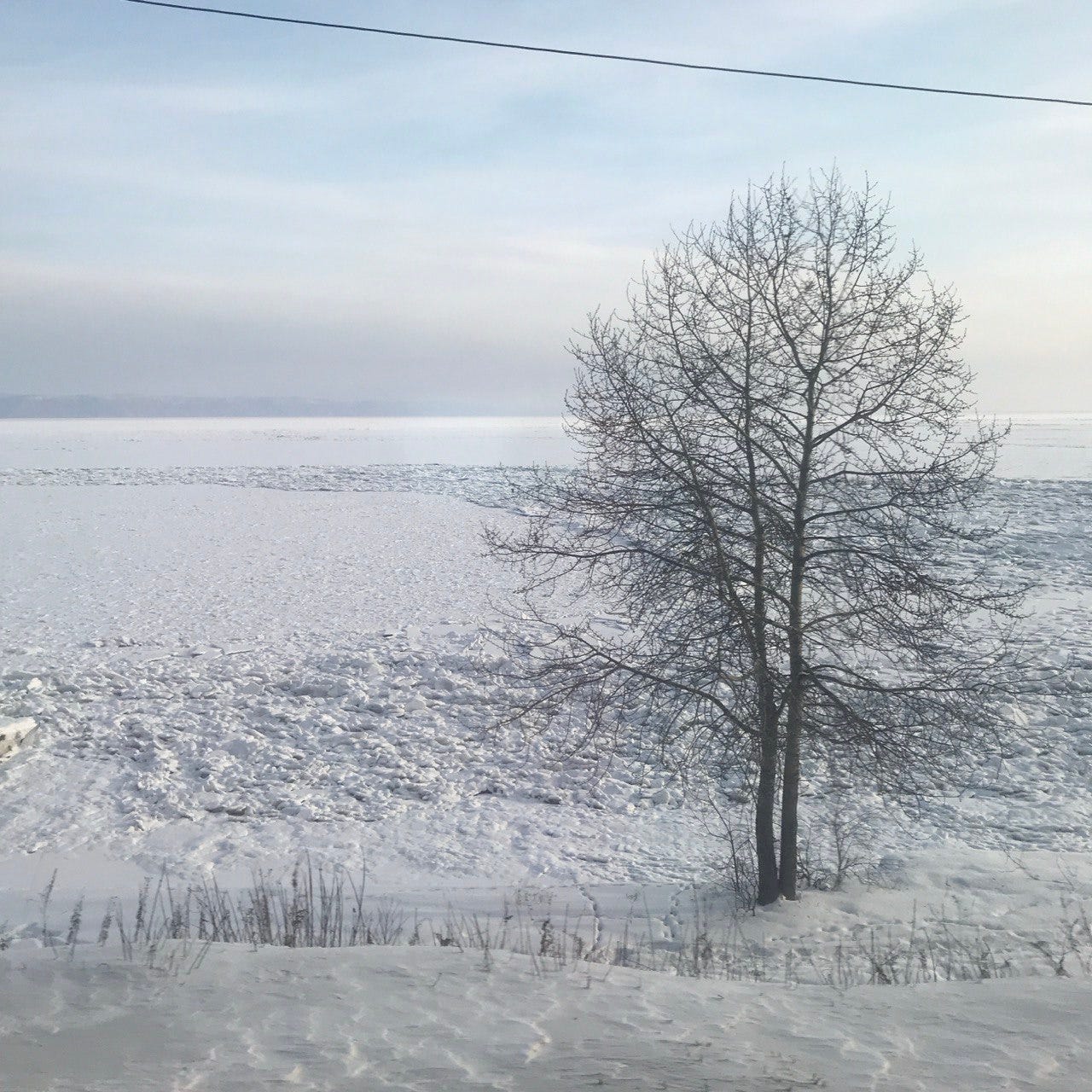
This week I would like to draw attention to the truly unimaginable situation on the ground in Ukraine as Russia has weaponized the coldest winter in years.

When something is horrible, but consistently horrible, and already reported on, it simply stops making headlines. Reminiscent of the old, now actually rather racist saying, ‘if a bicycle fell over in China’.
Ukrainians who manage to access the internet are now trying to tell the world what is happening, and today the news is incredibly bleak. The worst part is — there doesn’t appear to be any end in sight, not of the cold weather, and no hope for quick fixes to the infrastructure damaged by Russia’s relentless bombing campaign against Ukraine’s civilian popuation this winter. It is as if the battlefield has moved from the trenches of eastern Ukraine to the living rooms of apartment blocks unluckily located on Kyiv’s left bank of the Dnieper river (the entire region has no heat, for weeks now).
A Kyiv restaurant owner, now living in Vienna, showed me photos yesterday taken by a member of her staff who was volunteering to deliver hot meals to elderly people now stuck in utterly frozen apartments. It was heartbreaking to look at. Residents bundled in layers and layers of clothing in their own, very modest apartments. And unlike when the war first began, nearly four years ago, no one is rushing to move hundreds of thousands of people, actually millions now affected, out of their cold homes.
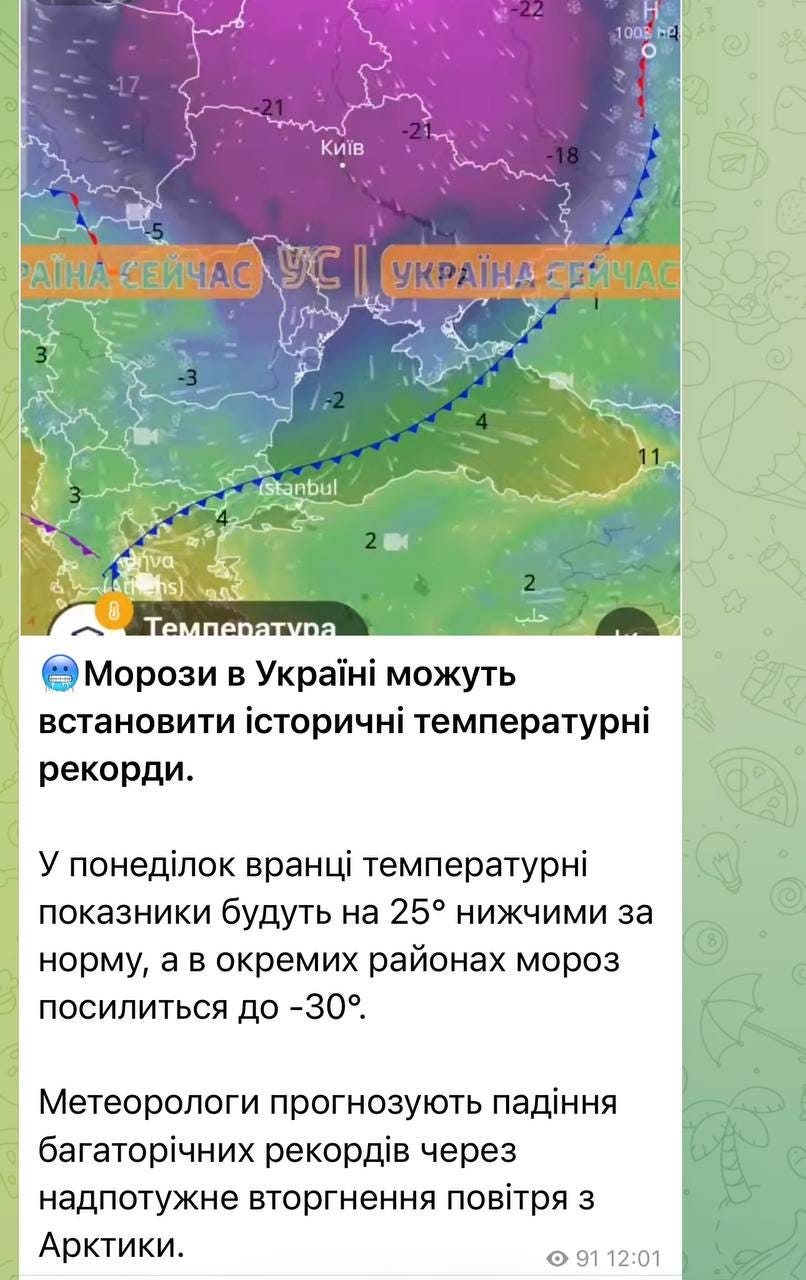
Temperatures in Ukraine this week are expected to go as low as -30C. Now imagine this without electricity or heating. It is a disaster. One the world observes from a distance, in horror, but what action can be taken now? You cannot rebuild a power plant or distribution grid overnight.
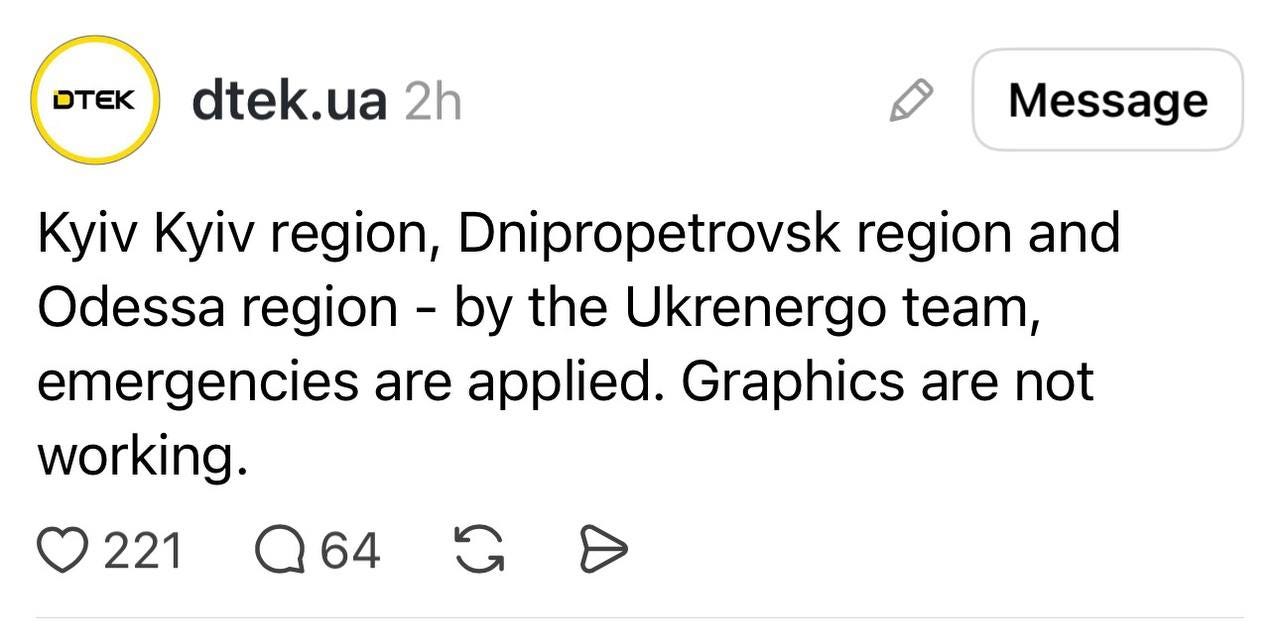
Ukraine’s electricity distributor is now warning that several major regions are without power and the usually graphics of rolling blackouts have been shelved. Now it is simply a blackout. The metro in Kyiv stopped working this morning with people inside. Two of three lines in Kharkiv are also not working.
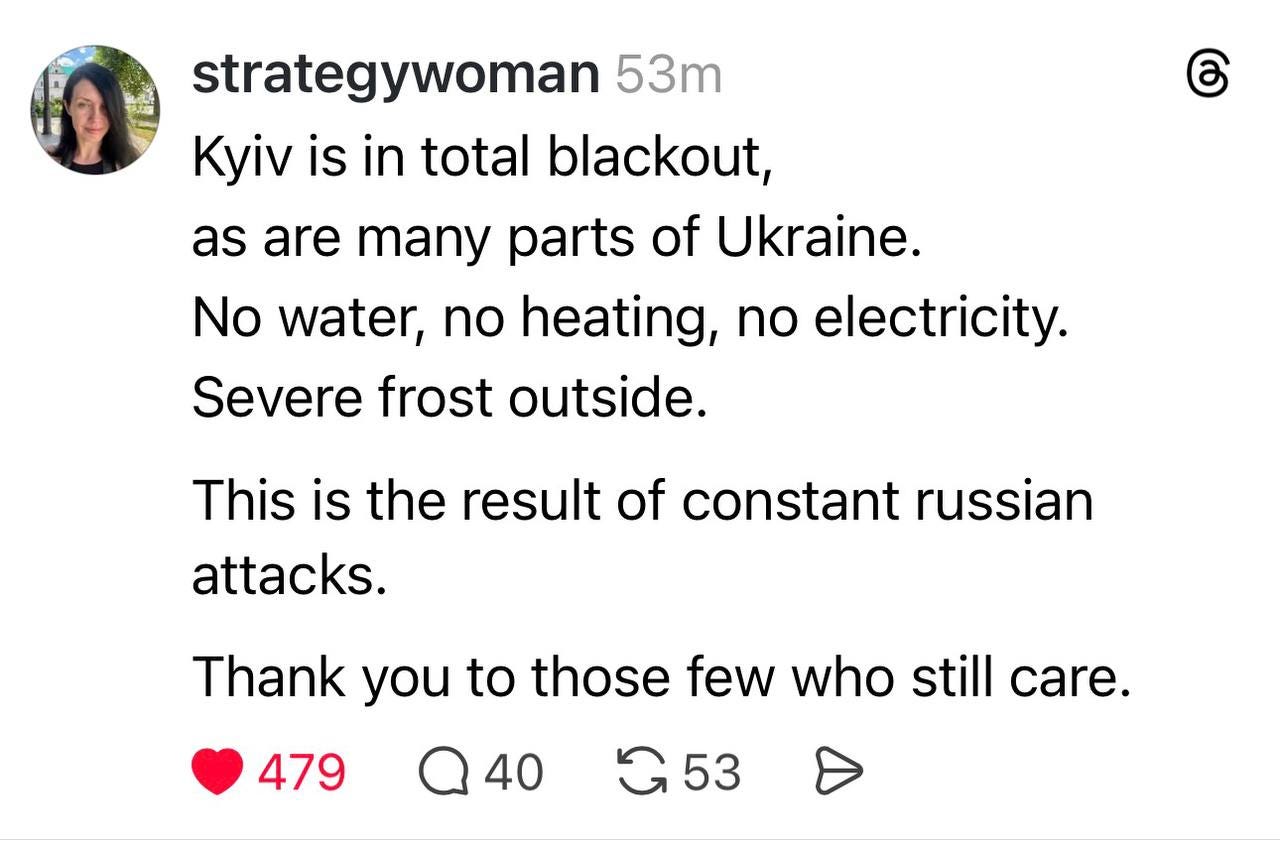
The messages read more and more desperately, and it is as if Europe’s politicians prefer to look away, as long as thousands of people are not arriving here at our train and bus stations. Not yet, at least. I fear those who remain in their cold homes do so because they cannot afford to leave. And Ukraine’s economy cannot afford to help them leave.
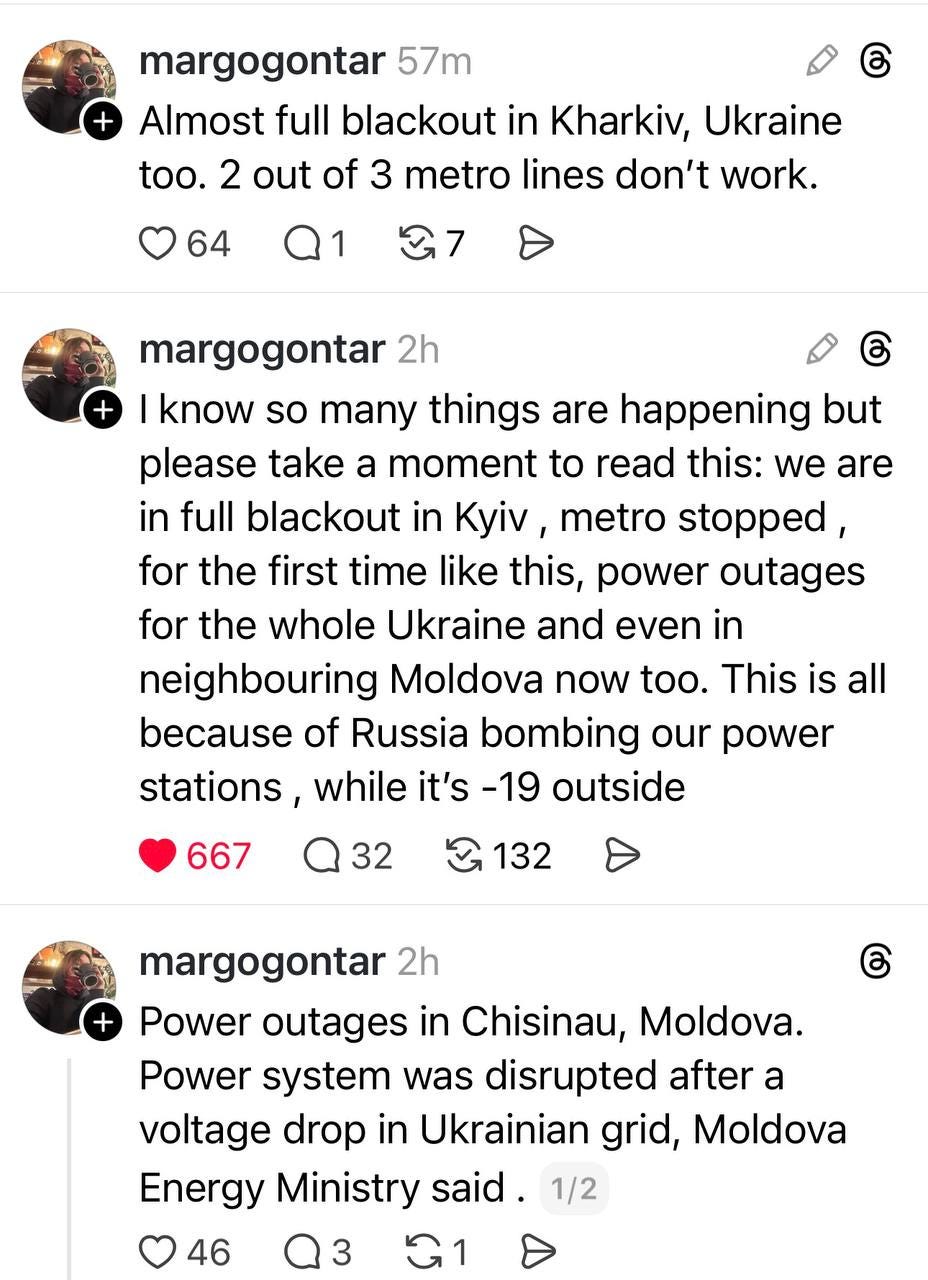
Now Moldova, too?
I feel it is important to lead with this news because I do not expect it to make headlines, with all the other drama happening in the world. I fear the new Melania movie will get more coverage than millions of people freezing in their own homes. Because that is, unfortunately, the state of the world we live in at the moment. America is also now arresting journalists.
I read online this week that Trump’s America still has a lot to learn about how to do propaganda right from Putin’s Russia. This is spot on. Let’s not also forget the reported $28 million Melania is reported to have been paid to make the film by Amazon. Exactly the way monolith corporations and oligarchs curry favour in autocratic countries. The only surprising part is the sloppy execution. But it will surely get better with practice.

I don’t know a lot about Don Lemon or his career, but most recently he appeared on Kara Swisher’s podcast in early January, and I remember then appreciating the frank and open conversation. I suppose the question is what happens now. Kara and Scott are calling on ordinary Americans to boycott major companies who are currying favor with the White House, but these calls to economic action by celebs rarely work in practice. Ordinary Americans have bills to pay, rent to make, and jobs they don’t want to lose. It is only the 1% who have the luxury of protesting with their credit cards. In Russia, as the state took over more companies, more people went silent, as suddenly their livelihood was tied to being quiet regarding the course of politics (more specifically, lack thereof) in Russia. It was an economic bargain, and Putin won. I think it is fair to assume the same thing is possible in the U.S. That if people have to choose between paying rent and defending the first amendment, they will choose rent.
In Russia, The Bell this week (paywall) put out a report detailing how the poorest regions have suffered the highest losses of men in the war. Which makes complete sense given Putin’s choice to steer away from further mobilization attemps in favor of using money, the prospect of multiples of one’s usual salary, to lure young men. There are countless online videos of Russian women encouraging their partners to sign up.
“However, research from The Bell found that there is a clear trend between regional living standards and how likely somebody from that region is to be killed on the front. The death rates correlate directly to one specific economic indicator: the number of people living below the poverty line (officially set at around 19,000 rubles ($250) a month).”
But as The Bell also reported, Russia is starting this year in the red, with oil and gas revenues under pressure. All of this helps to explain, at least in part, why Russia has chosen the cruelest, most traditional of centuries of Russian autocracy means of waging war: simply harnessing the cold of winter. This time via strikes on Ukraine’s utilities which simply cannot be switched back on when the damage is too great. And herein lies the biggest problem, aside from the immediate humanitarian crisis from the incredibly cold temperatures now affecting much of Ukraine: none of this can be fixed overnight. Repairs will take months, years. So even if the war ends tomorrow (wishful thinking), the electricity would not just suddenly switch back on. Europe has a major problem, even if for now it feels like that “problem” has chosen to stay put in Ukraine.
Here in Austria, Ukrainians ask me what will happen if the EU does not renew their “temporary protection” status after March 2027. At the moment, the European countries who have given Ukrainians temporary residency have done so under the EU umbrella mandate. However, there are rumors that after March 2027 the decision will be shifted to individual countries, which means it is theoretically entirely possible that some EU countries will only allow Ukrainians to stay legally who are working here and can support themselves, and that again, in theory, others who are still receiving social payments for a myriad of reasons (parents of disabled children, pensioners, mentally ill, etc.) will no longer have a means of staying legally and supporting themselves. This, of course, is already creating a lot of stress.
This week I met a mother in Vienna who is here alone with her 15 year old son. They are from Kharkiv. Her son is severely autistic and also suffers from a form of epilepsy in which he experiences daily tremors and mini-seizures. He attends a special school in Vienna, and the city provides transportation for him. They live in a shared room in a dorm, and cook in a shared kitchen. The mother has not even been able to attend a German class yet, because she cannot leave him alone, and he has missed weeks of school in the past due to health problems which landed her son in the hospital for observation. She asks me, with a really desperate look in her eyes, what will happen to them, and I have to be brutally honest and say, in my opinion, anything is possible.
There are men here in Europe who ran across the border and whose passports will soon expire but they cannot renew them because if they do they will be signed up for the army. They soon will have no valid travel document with which to extend their residence permits even if they are working and financially self-sufficient.
There are pensioners, mothers of kids with serious health issues, and those suffering from mental illness. Just like in any society, but those Ukrainians may lose both their legal right to remain in the European countries they now call home (some for nearly four years already) and the meager basic payments they live off of, and then what? It is hard to imagine a world in which they can return to Ukraine and access support there, as at the moment several huge Ukrainian cities cannot provide basic things like electricity and heat to those who chose to remain. This is all a ticking time bomb, but one that does not make headlines.
Ukrainians now make up 1% of the population in Austria.
A mother wrote me this morning. They are living in social housing in Lower Austria. Her daughter studied so hard, got straight As, and now wants to apply to a high school next week. They just got told they have to move to new housing this week, and the address will be too far away. The mother is devastated, and asks me who can give her a registration paper with a closer address, like, today.
I often think of how many millions, billions of lives are irrevocably altered by the whims of a handful of people, and how cruel that is sometimes. I didn’t have any good advice to give her. I told her to show the old address, even though I understand that it is, technically speaking, an electronic database. Maybe the school won’t double check. Maybe she can convince the charity housing them not to move them, not to make the kid switch schools mid-year. Everything feels so precarious, as if the rug can be pulled out of your life at any moment. A matter of luck, or fate if you believe in that sort of thing.
In closing, I would like to recommend this long read, which prompted me to order the book. I found it fascinating. I had heard about this story before, but never in this detail.
A century in the Siberian wilderness: the Old Believers who time forgot
I also just ordered The Correspondent which so many people have been raving about. After seeing the author’s interview with Katie Couric, I decided to find out what the fuss is all about. I love that the book was not marketed as a soon-to-be-bestseller, but rather grew in popularity solely through word of mouth, and also that the author, Virginia Evans, basically wrote it as a detox for herself after her first novel died on submission (meaning an agent signed her but failed to sell it to a publisher).

I think that is all I have for today. I also wanted to simply point out the major purge of China’s military top leadership, because it feels important, but I have no insights to add on top of what has been reported in the press. This Economist video is a good overview:
Thank you for reading! This week are school holidays in Austria, and I am childfree, which means I have the opportunity to do a bit of on-the-ground-reporting (me sort of living out my never fulfilled dream of working as a “real” journalist), so stay tuned for something a little different next week.