
Hope
In this last post before the new year, I try to look at the positives. Well, sort of.

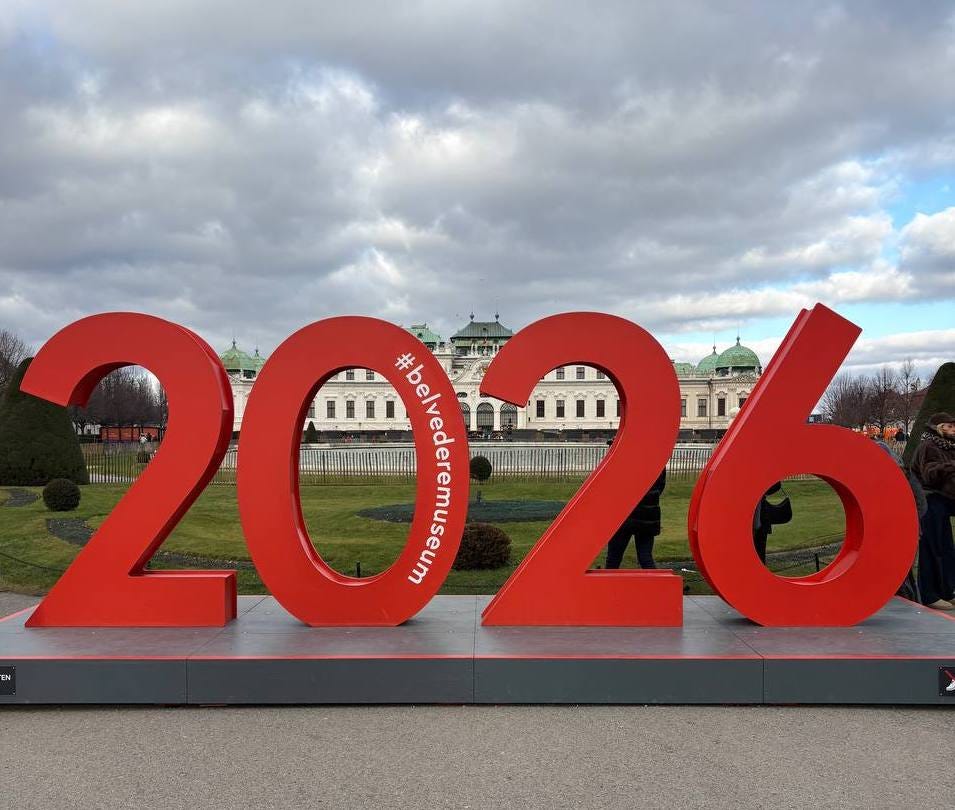
I love the dead time between Christmas and New Year’s when you don’t actually have to report for duty anywhere, you don’t have to wake up at a certain time, it is perfectly within the range of justifiable behavior to lounge all day in one’s pajamas, and mealtimes become something abstract, open to individual interpretation. But there are limitations to the socially acceptible laziness, and as the sun finally tried to break through the clouds above Vienna for a few hours, despite the cold winds, I forced my youngest to walk to a nearby museum, arguing a little culture on a Sunday afternoon never hurt anyone.
My first surprise were the dozens of tourists, all bundled up because despite the lack of snow, it is actually freezing outside and the wind whips around your face, crawls under your wooly hat, and generally makes you question why you thought leaving your home was a good idea in the first place. I stood patiently, trying to wait for everyone to stop posing in front of the giant red 2026 so I could take a photo empty of tourists. I soon realized this would only be possible if I opened my mouth, so I became that annoying person, asking everyone to stay out of my shot. One woman looked at me and said “will you take our photo?” and my reply was “sure but first I need you to get out of my shot!”. My teenager was embarrassed. I got my shot and helped them get theirs.
Past the Christmas market (remarkably still open and filled with people despite the freezing temps), walk through the gardens to the museum, line up for tickets, gulp at the cost (€19 per adult), gulp twice when told it would be a forty minute wait to enter, do some quick girl math and promise the kid a matcha and a corn dog instead of the museum. You should have seen the kid’s smile.
Another brisk, cold walk and we were inside a packed matcha shop where a group of Spanish young women were so relaxed they were hitting their vapes indoors, ignoring the stares of shocked locals (Austria is usually pretty strict with this stuff meaning it needs to stay outside). The corn dog place was so popular that people were actually eating outside, like you could see their breath while they talked, and still, they were happy to sit in the cold and enjoy this relatively affordable piece of fried happiness. It was somehow sweet.
The tourists this season have irritated many locals — there are so many of them, they clog up public transport on some of our most used routes, and yet, the simple fact that people are still willing to spend money, get on airplanes and trains, and come experience Vienna’s sort of was-once-majestic retro, old school beauty, gives me a certain hope. Because I see a very different side of Vienna in my daily life. I see the bureaucracies which refugees and immigrants are up against in their struggles to stand on their own feet financially, find jobs, educate their children, and built new lives here. I see the healthcare system which is simply not really coping anymore with the strain of a state-funded program of care for all when there are no co-pays for visits and hospitals feel very much, on a day-to-day basis, overcrowded and overworked.
I know much more about Austria’s educational system than I would ever wish upon anyone and one of my biggest regrets, retrospectively, is not putting my most creative, most academically challenged child, into a different system. Now it is too late, but I wonder about what could have been. The other day she opened her computer and showed me the most beautiful pieces of creative writing, from when she was only 13. Stories she wrote, quite literally, while bored in school. She never ever encountered a teacher in her formal education to encourage that kind of creativity, in any language. Creativity does not pass exams, and exams determine your future. All very fair and rigid, rigid and fair. Except of course if you are born into the wrong family speaking the wrong language. To this day, my kid only ever showed those beautiful stories to a few friends. It sort of broke my mother heart. She had hidden them even from me. No one ever lifted up her self confidence with praise of her artistic talent. I said all the things in the moment, but they were five years too late.
As Europe diverges further away from America, I often walk around European cities, like Vienna where I live or Paris which we visited recently, and think wow this is beautiful, how long will this all be maintainable for. I have serious concerns about the economic viability of the European social democratic experiment. I don’t see innovation here, entrepreneurship is rarely encouraged nor promoted, and the economic system is essentially taxed to death. The machine will keep chugging along, and then one day, the wheels will simply fall off. I have no idea what profession to advise my teenagers to choose should they stay in Europe. I have no rose-colored glasses when it comes to America, I understand it is a deeply divided country, nepotism and wealth inequality has nearly killed the American dream (nearly), and yet, and perhaps this is simply because I am far removed geographically, I still think of America as a place where dreams can come true. Europe? Not so sure. Great place to holiday. Much harder to make a living. For many, the European social democratic proposition of less work, less pay, less extras, less stress is appealing. I understand that. But I don’t think it will be financially sustainable forever, and I don’t see politicians moving to change our societal structures in a way to think about the future.
The great innovations of red Vienna, for example, like affordable public housing, those were first built over a century ago. Public transport? Amazing, but built decades ago, and recent attempts to add an additional subway line have so far only resulted in years and millions wasted, and now reports of structural damage to buildings and an existing subway line in the vicinity. The city’s amazing public pools in nearly every district? Only one new built in the past twenty years or so. In other words, it’s all great, but none of it is new, and it is all aging infrastructure. It was all built for a relatively homogeneous society of mostly working class people that is no longer. Today’s challenges are just so much harder. They aren’t so much about hardwave but about how to educate a generation of kids coming from different religious and ethnic backgrounds who hear German for the first time when they start kindergarten, whose parents often cannot read books with them in German once they start school. Innovators aren’t actively seeking to build businesses here. They are in North America and in Asia. Even German cars, solidly a symbol of European quality and innovation, are no longer what they once were. Most young Europeans these days can hardly afford to buy a car at all (not that you need one in most urban areas, thanks to public transport and ride sharing companies like Estonia’s Bolt and Uber).
And then I hear news which makes my head do a 360 degree spin (as if that were theoretically, anatomically possible). I received a call the other day from a Ukrainian man who is working in a hotel here. He met his “wife” (they are not technically married yet because she was still technically married to her first husband when they got together) in Vienna. They are now proud parents to a one year-old daughter (his first child, her fourth). Money is tight as his salary is modest. They are not married yet because she only just now managed to officially divorce her first husband. He isn’t even on his child’s birth certificate yet because of this technicality. She has big kids, like late teens, and four kids is enough to keep anyone on their toes, but on a limited budget, in a new country, without language skills? I would go insane, but that’s perhaps a me problem.
Anyway, the phone call. The father calls me up and casually announces that his wife is pregnant again, and could I please help them to register her to give birth at the university clinic, because she will surely be classified as a high-risk pregnancy (maternal age, plus their baby girl was born with some serious health problems which may be genetic). I took a deep breath and ensured I said a solid, enthusiastic “congratulations” to both parents before I began to give advice on registering for the birth. After I got off the call, I was just stunned: stunned by the decision to have yet another child, stunned by the positivity, the optimism, the lack of fear in their voices. Maybe the world needs more of that. Maybe there is a lesson there for all of us. I do of course feel sorry for the older children because I know as a mom of three (who could definitely never ever have handled four or more) you often feel pulled in three different directions. But in general, I am in awe of people out there just living their lives, not worrying about all the reasons not to do something. The story gave me some kind of strange renewed faith in love, because that has to be the reason they have decided to bring another child into the world. The war in Ukraine never stopped Ukrainians from living. They are just doing it now across many different countries, under many different circumstances.
It is the same when you hear reports from Ukraine after yet another horrible night of attacks by Russia, and then the journalists interview young families, and you think…you have a small child, why didn’t you leave? But the answer isn’t that simple. For many couples the idea of spending years apart is equivalent to a death sentence to their marriages, and this is understandable. But then you see photos like this one, from Moscow’s latest bombardment of apartment buildlings in Kyiv, and you wonder how much longer ordinary Ukrainians can live like this, playing these odds.
I understand there are supposed to be some sort of talks in Florida. As I wrote last time, I cannot seem to bring myself to put the words “peace” and “Florida” in the same sentence because it just feels ridiculous to imagine the fate of Ukraine being decided in some posh Miami restaurant serving $25 cocktails. Zelensky has apparently just arrived in Florida, so there is that. He has to look in front of the Ukrainian people like he is doing something. But when you read the news from the ground, from blackouts to losses on the battlefields, the situation appears really not great. Really not sustainable.
I have also been thinking a lot about Russia this week. If you read between the lines on social media, many Russians who live abroad and have returned home for the holidays find the prices very high, and are annoyed with the new practice of cutting off their mobile internet for the first two days back in the country. This is a new measure amongst many aimed at tightening the Russian authorities’ grip over everything that is internet-based communication and exchange of information. Russia’s economy going into 2026 appears to need the war to continue as it is the only source of growth, and yet the Russian population does not want this. Russia has no plan if the war were to end tomorrow. Therefore it is hard for me personally to believe Putin actually has a genuine interest in ending it now. He has solved the manpower problem with money and not reinstating what would surely be a deeply unpopular mobilisation process. For the history books, I believe he thinks he could still achieve a better “map”.
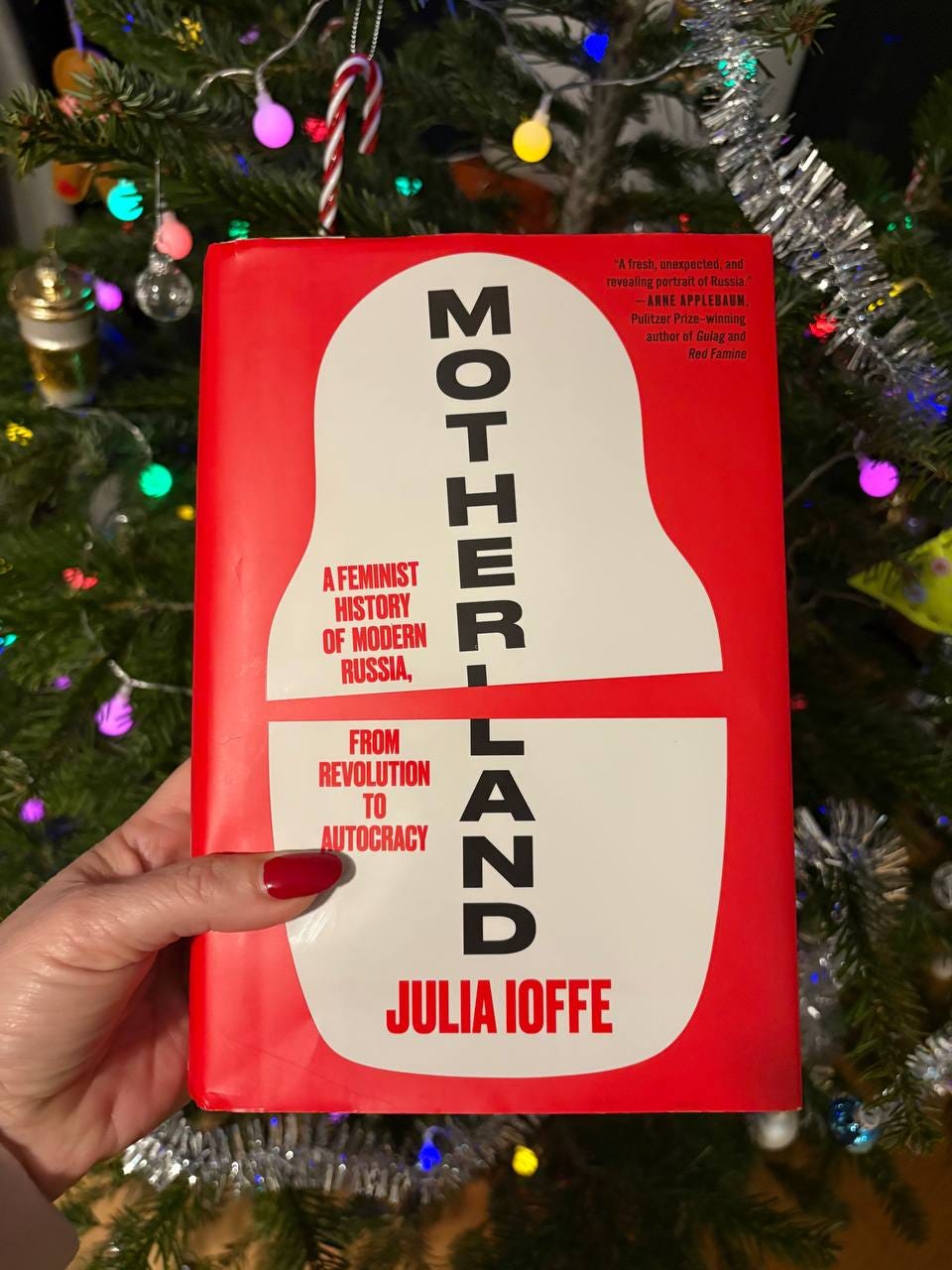
I finally finished Julia Ioffe’s epic Motherland over the break. As someone who lived in Russia for many years and has read nearly every book written in English on Russia over the past few decades, I never pick up a book on Russia expecting to learn a lot of new information, but Motherland blew me away. I learned so much. From early Soviet history as it relates to women, to Julia’s incredible story of her own Jewish family and their 20th century lived experiences, the book is deeply reported, and heavy. I had to take breaks while reading it. The parts about Beria shocked me; I had walked a million times past that blue buildling on Malaya Nikitskaya.
Perhaps Julia’s book tries to cover too much in too many pages, but I understand now why it took her years to write it, and why perhaps editors couldn’t decide what to cut, because it all feels important and somehow all ties together. A lot of her writing focuses on famous Russian women, the wives of politicians and leaders in their own right. I tend to prefer ordinary stories. There are plenty of these too. Julia’s writing really helps the reader to understand the moments in time on a basic, day-to-day level. The book is incredibly intellectual, in parts perhaps too much so to be appealing to wide audiences, but I finished it and thought wow, that was one hell of a project, to do all that research and put all those words to paper. Julia’s family story is the thread which weaves throughout the history and makes the book often read like a novel.
Did any of you manage to watch Heated Rivalry? I have been telling everyone I know about it, receiving a lot of eye rolls in the process, but I am happy to see that the show has found so many fans beyond the usual consumers of gay romance, hockey romance, Canadian stories in general (none of which I have ever read). I think perhaps in these times, and 2025 certainly falls under this category, when so much seems so terrible all at once, an unconventional, forbidden love story featuring beautiful young people found a way to melt the hearts of so many of us, and offered hope in a time when there isn’t much going around if you look purely at the facts.
I have even read commentary online from middle aged people who themselves wrote they gave up on love a long time ago, but are now considering putting themselves out there again, in the hope that perhaps there is a tiny chance that they too could experience the same kind of love the story portrays. It is also the story of an underdog — a low budget production which became wildly successful, thrusting everyone from book author to producer to lead actors into a spotlight few could have imagined when they began filming. The authenticity is what has appealed to audiences, too. Many are begging the creators, now set to film a second season, not to abandon that ethos. The story and the acting takes center stage without a huge production budget, just like in the best of cinema or theater. Perhaps we all simply need more art in our lives.
I saw a clip recently from someone who works in publishing explaining that sometimes writers write books as a therapautic process (she said this far more eloquently), but that doesn’t necessarily mean that those words put on paper by that writer will have mass appeal. But the process of putting those thoughts on paper, for that writer, is an art form, and a very important one for the individual writer, a form of therapy. She made it sound as if the process of engaging in this kind of mental therapy is important in its own right. Whether or not those words on paper would have appeal to a broader audience is secondary. I think her point was that if people feel compelled to express themselves, we should all continue to make art for art’s sake. I think if you focus on what sells, you may end up creating just that — art that sells — but you may not address the first question. Julia’s book is an example of “write the book that only you could write” because truly no one else could have written it. And that is a beautiful thing.
This coming year I am expecting another round birthday, and rather than dreading the arrival of the date on the calendar, I think I will try to focus more on this question of art, understanding how finite our time is on this earth, and trying to engage in those things which help us to grow and to love and to create. For me, putting words on paper (screen) each week is definitely thereapeutic, and I am grateful to have found a small community of readers who seem to enjoy engaging with my work. I hope to expand my range of topics, and try to find a home for some of the art I have created in recent years but haven’t shared yet. I suppose I need to answer the question above first — was it simply therapy, or does it have broad appeal?
When I get discouraged, I think about some of the conversations I read in a daily basis in my Telegram group for Ukrainians here in Austria. A single mom, raising a toddler born here, whose husband is serving in the Ukrainian army, has been trying for months to find a job, any job. The catch is of course that she can only work something like 16-20 hours per week, because she is limited to the hours in which she can leave her son in kindergarten (I write this with an understanding of the great privelege that is essentially free childcare in many European countries — but it is rigid). She has been sending out her resume for months, contacting every type of employer in her neighborhood she can think of, and nothing. And yet, after months of no replies and rejections, she still hasn’t given up. She is still asking how to improve her application. From an economic sense, the absurdity of the situation is clear. Why would an employer take a chance on a single mum with a young kid who can only work limited hours when you could simply hire someone else without this baggage? On a human level, you really hope she manages to find something, that someone will take pity and agree to hire her, to compromise by hiring an employee for less hours than they would usually need. I hear stories all the time from Ukrainians who managed to find work with little or no German skills. It is hard, but not impossible.
We all need a few Christmas miracles from time to time sprinkled throughout the year.
I once greeted the new year on Red Square, in the year 2000, and we wrote our little hopes and dreams onto tiny pieces of paper and then set them on fire as we drank those ashes with the Soviet champagne we poured from a heavy green bottle into the plastic cups we had brought with us. My Russian friends explained this was a tradition, to make fireball wishes going into the new year. Wishes seem somehow more fun than resolutions. Resolutions imply hard work; wishes require a bit of luck and the universe and the stars to align in your favor. The reality is we probably all need both in our lives. A dream and the strength, both mental and physical, to do the work to make it a reality.
Thank you for reading. Wishing you all the best for the new year! I’ll be back soon.
Thanks again for sharing your thoughts and experiences. May real peace may come to Ukraine soon 🙏🏼