
Mirages
A little bit of everything this week: Trump's cyber millions, Trump tariffs & small businesses, leaders calling in sick ahead of May 9 Moscow, a moving long read, the future of Europe.

I have been thinking of mirages as the weather plays tricks on us. We enjoyed a long weekend here in Austria (“red” Vienna still celebrates labor day on May 1 by giving nearly everyone the day off, and as it fell on a Thursday, Friday also morphed into a day off for many) with summer-like temperatures, the pools opened, it became possible suddenly to go outside without a jacket and actually fry oneself in the sun, should that be your idea of a little fun. And then just like that, poof, thunderstorms and lightening, torrential showers, an almost-rained out food festival (we did manage to buy some very over-priced Thai iced tea, mango and sticky rice, and shrimp tempura, but only on the second attempt), and we are back to gray, wet skies which make May feel like November’s dishonest cousin.
The most interesting news I consumed all week was fascinating reporting by Eric Lipton & team of the New York Times on Trump’s crypto business. I shared a link to a gift article here, but to be honest I listened to the interview on The Daily with Eric Lipton, and it was so helpful to hear him break everything down step by step. A lot of people hear the word “crypto” and sort of cringe and then switch off. I get it. But in this case, I think the Trump family is getting away with all this in large part because it is not well known nor understood. And of course clearly it is a legal gray area and when you are your own referee, as Trump appears to be at the moment, basically legislating with Executive Orders, bypassing Congress, I would not even try to argue that any of this is illegal. But there is clearly a problem, to put it mildly, when anyone or any entity can hide behind the secrecy of crypto transactions to pour funds into a Trump enterprise. The public will not know which actors, foreign or domestic, are investing, but you can bet team Trump will have a good idea, just like those who manage a casino know who their regular high rollers are.
I thought the most interesting tidbit was their introduction of a “stable coin”: I am terrible at explaining this stuff but just imagine you have one Bitcoin whose value fluctuates day by day (the crypto markets never actually close). As I write this, one Bitcoin is worth $94,432. If you want to “cash” out that Bitcoin, you can sell it for USDT (Tether), which is a stable coin in which one coin always equals one US dollar. I think it is fair to say that crypto is widely used for all sorts of transactions in the gray (e.g. not legal in the traditional sense of the word) economy, for narcotrafficking to money laundering and real estate purchases in countries which have given a green light to the use of crypto for large transactions. These players also need to be able to fix purchase prices using stable coins. World Liberty (the name alone has a you-can’t-make-it-up quality about it, doesn’t it? Also sounds to me a bit like something that crashed in 2008) has apparently already secured 1 billion U.S. dollars (yes, you read that correctly) towards its own USD-pegged stable coin it plans to issue on Binance:
“Jordi Alexander, a crypto executive who helped World Liberty with its plans to launch its stablecoin, said in an interview that the company had already secured commitments of at least $1 billion from investors to buy the stablecoin once it hits the market. On Tuesday, Zach Witkoff confirmed that World Liberty had reached that mark.”
I don’t see Democrats nor the American public catching up on this fast enough to do anything about it. I can only say I really recommend everyone to read the article word for word. Those in the crypto industry celebrated Trump’s election as he had hinted during his campaign at the idea of creating a U.S. national crypto reserve. Now, however, it reads as if team Trump has enriched itself buy raising money and then buying a bunch of real coins with real value. And they are just getting started. If this was happening in any other country, it would be called something else entirely. Old-school dictators like Putin simply re-nationalized major assets which were privatized by his predecessor, new-school dictators like Xi have built a new, modern export-oriented economy around the country’s core competencies and without having to deal with pesky things like democracy and voters, but what will Trump do? This has nothing to do with actually rebuildilng America into something better. This reads like enrichment of self and those close to him. It is totally understandable why foreign players in the crypto industry and way beyond would like to curry favour. After all, it has become painfully clear the damage Trump is capable of inflicting on the world economy with the swipe of his pen (Sharpie).
I came across this video a few days ago on TikTok which shares the impact of the Trump China tariffs on American small businesses reliant on China for production. This young woman, like many other American small (and not only — Amazon was called “hostile” by the White House for contemplating breaking out the price impact of the tariffs) business owners, will be listing the price increases for her customers and showing how much is directly due to Trump removing the “loophole” which existed for such imports which was now removed.
Amazon, of course, quickly bowed down to Trump.
“The team that runs our ultra-low-cost Amazon Haul store considered the idea of listing import charges on certain products. This was never approved and is not going to happen,” said Tim Doyle, Amazon spokesperson.
The markets have bounced back, a little bit, and everyone seems to be somehow adjusting to the “new normal”, lest we forget it is an entirely man-made problem. Everyone, of course, except all the unseen, invisible to the giant corporations and the White House, small business owners, for home this loophole was not a scam but a lifeline, as many of their innovative products designed by Americans, bought by Americans, can at the moment only be made at an economically-effective price in China.
The solution seems to be a bit like Russia does at the moment to avoid sanctions, with things being exported by Latvia or Kazakhstan instead.
“The de minimis exemption still applies to non-China countries,” he said Friday. “I expect to see the Chinese e-commerce retailers adapt by using countries like Mexico and Canada as collection points for low-value packages.”
It isn’t clear to me who Trump thinks the winners are in this scenario. Americans are not going to start manufacturing like Asian countries do overnight. Americans don’t want to work factory jobs anymore. We thrive at innovation, design, and marketing (although if you look at what is happening in Asia you might ask if that is even true anymore).
In other news, I read with curiousity about Serbian president Vučić abruptly cutting his trip to the U.S. short due to “health issues”. This was before he was due to meet with Trump. Speculation, from what I have read, is that Vučić wanted to avoid being a messenger and also from having to be on Red Square on May 9, when Russia will celebrate the 80th anniversary of the Soviet Unions defeat of facism (this is essentially how it is seen in Russia; they even celebrate on a different day than Europe as it was already May 9 not 8 Moscow-time when Germany surrendered). Slovakia’s president is also reportedly ill. Serbian independent media asked why no medical report was provided after the country’s president was discharged after spending 17 hours in hospital upon his return from the U.S.
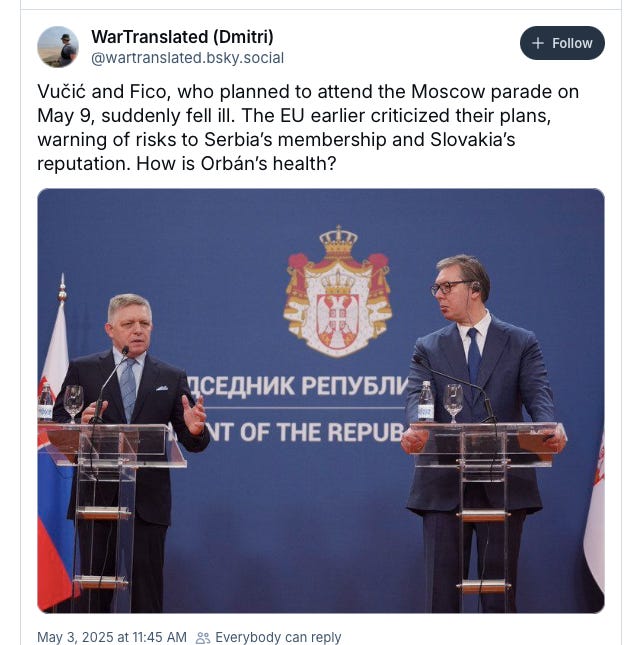
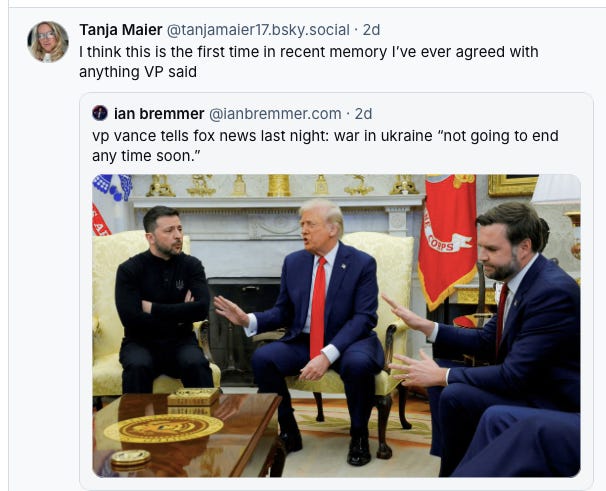
It is a difficult line to walk for a small country leader who needs to keep the EU happy while not entirely pissing off big brother Putin. I can imagine one might really want to avoid standing there on May 9, but the illness occurred a bit too early for this theory. I was genuinely surprised to read China’s Xi will be on Moscow on May 9, which seems like a huge win for Putin, who asked for a cease fire for several days (Moscow airports are already not entirely working ahead of the big day, and mobile data will be jammed on purpose for days in advance), to which Zelensky replied the proposal was “theatrical” and rejected it. Russia continues to bomb Ukrainian civilians nearly every night. This no longer makes headlines, but it doesn’t mean it has stopped. The only thing that ever came out of JD Vance’s mouth which I agreed with, to my knowledge, was his comment recently about the war in Ukraine “not going to end anytime soon”. This is, unfortunately, an accurate take.
Trump couldn’t get Putin to give on on any of his positions (not that they really tried to push him hard), it is understandable why a Ukrainian leader cannot agree to what is on the table at the moment (although personally I think they are ready to talk, the problem is not so much even the terms — I think lost territory is accepted as lost, even if they do not say that publicly, but that the negotiating partner simply cannot be trusted. Trump must smell this too (I do not agree with those who think he is stupid), and therefore is like…well we tried, not going to happen, they (the proverbial they, meaning everyone and anyone) don’t want to make a deal. And he wipes his hands of it.
I generally try and avoid commenting or writing about parts of the world I feel underqualified to have an opinion on. This includes the war in Israel. I asked a friend recently, who has family there, how the election of Trump was viewed in Israel. To my genuine surprise, I was told it was celebrated. I wondered if the view from Israel depends on who you are talking to. What I was doing was the same as asking the taxi driver what he thinks. It isn’t representative. Another friend was flying back from Israel this weekend, and was stuck for a while when the Tel Aviv airport temporarily closed after a missle from Yemen (remember the Signal group chat, fired from those rebels the Americans had sought to strike from the air) somehow managed to get past the Iron Dome. I thought it sounded really scary. All the other airlines cancelled their flights. El Al kept flying. A Russian friend told me her friends from Moscow are also still coming to Israel. El Al still flies direct flights to Moscow. I had no idea.
And then I opened the New York times. And I read this. And I don’t know what to say so I am just going to leave it here. It seems like it is ordinary people who suffer everywhere, whether it be Gaza or Ukraine. In the case of Gaza, one can argue the political leadership originally set its trapped citizens up to be victims, and in the case of Ukraine, you cannot make this argument. In both cases, I don’t know how you achieve a lasting peace. The one thing I have noticed is that as the years go on, and perhaps it is the age of the people I am speaking with, the views on all sides become more entrenched. It reminds me of the polarization of the Balkans in the 90s. On a much larger scale. And yet they stopped killing each other. Eventually. For now.
On this topic, I stumbled upon this very fascinating, if difficult, long read/listen on the generation of Holocaust survivors who are nearly all gone from us, written by the one and only Taffy, who I came to love from her memorable celebrity profiles as a magazine writer. I like her approach to writing this story, drawing on her own desire to leave the past in the past, to not have her own life burdoned by the inheritance of a legacy, a story you didn’t live.
I don’t know how to process the history and the present, which seem in such contrast to each other. It seems these days that all viewpoints are becoming more radical, no matter which direction you look.
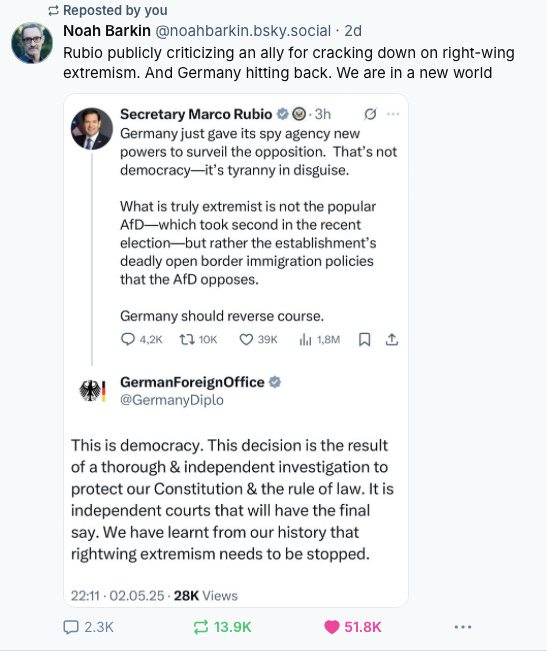
This was an actual conversation this week between the U.S. Secretary of State (and now head of NSA!) and the German foreign ministry on social media:
And Europe, what is happening here? It feels a bit like running on autopilot. Defense spending is increasing, the Russian threat is not forgotten, but democracies are trying to continue to govern by coalition, as they have grown accustomed, and yet I wonder who, if anyone, is making the really big-picture, long-term decisions, about the directions of the economy or society. Will Europe be able to re-invent itself, or will it slowly morph into Disneyland-for-adults, with palaces on display, ancient art in musuems, picturesque seaside resorts, snowy slopes, something constant in contrast to Asia’s offering of “see 2050 now”. When I see young Asian tourists taking Vienna in now, I am so curious to ask them, and what does it feel like, to go back in time? What are your impressions of our infrastructure, much of which looks like it did when it was built decades ago?
How will Europe integrate the new ethnicities which now make up large minorities across several major countries? The EU was one thing, putting together many nations towards a common goal, who once saw each other as foes, but how will it build a next generation with children who have been raised in homes by parents who are not ethically European, who came here as adults, in search of a better life? I see the young men wandering Vienna’s streets in the evenings, and I wonder what they are being offered, and where/how they envision their own futures. To me, it feels like the problem politicians keep kicking the can on. The far right just focuses on racist stereotypes, and “send them home” rhetoric. The far left wants to feed and clothe and house everyone and anyone (the math doesn’t math, obviously). The center is frustrated by the benefits and rules which restrict motivation and ability to find gainful employment.
Russia has reportedly even been recruiting unsuspecting Ukrainians and Belarussians in its campaigns for small-scale sabotage and arson just to upset Europe, just to create little fires within. This is fascinating reporting by Shawn Walker of The Guardian. (The Guardian also put together a huge recent report on torture inside Russia’s prison camps here)
But to be fair, this all is only part of a much bigger issue: what exactly is Europe offering as its vision of the future for young people? How does Europe see its own future? I cannot answer that quesion. As a mother of three teenagers, this concerns me. I do not blink when my kids say they see their futures elsewhere. This does not surprise me, and yet on paper, Europeans still have very good quality of life. But it is as if everyone knows it is all a ticking time bomb. A mirage. Until the math doesn’t math anymore, and our societies have morphed into something else, without the invisible glue that binds us. It feels like a time for strong, brave leadership (I don’t mean that in the dictatorship sense, obviously). I am curious if we will see it emerge. Or simply stagnate. Slowly, almost invisibly in beautiful surroundings. The imperial buildings, I am reminded as I walk Vienna’s beautiful streets, will survive all of us.
You are such a good writer and I learn something every time I read your musings
Idk, maybe Europe will not have a bright future, but where is a better place? I don't know. For the coming years, Europe seems to me still a better place to live than anywhere else. But we shall see, of course.
Thank you for your writing, dear Tanja!