
Shanghai
I recently returned from five days in Shanghai with my daughters. We were blown away by modern China. Plus an emotional read from Kyiv, analyst No. 3 in the Strait of Hormuz, and "lobster mania".

I had meant to sit down and write this on Easter Sunday (a holiday I mostly associate with the misery of allergy season and closed grocery stores in Europe), but unfortunately we also brought some form of a “man cold” back from China. At first I was downing antihistimines like uppers, but then I realized they weren’t doing anything, and all I wanted to do was crawl back to bed at all hours of the day and night. Today I managed to acquire what is over-the-counter cold medicine in most English-speaking countries, but for some reason an Austrian pharmacist insisted I needed a prescription to buy, at which point I muttered something about being here 13 years already and never having been told that before, walked to a second pharmacy, and got the drugs. As the song goes, I took the drugs, and the drugs are working, so before they wear off, let me share with you my impressions of our trip to Shanghai last week.
I must preface by saying that it was a a lifelong dream to visit China one day, and we did that a year ago, with a visit to Beijing (wrote about that trip here). This time we had, thankfully, a direct flight to Shanghai. It is now possible to visit China as an EU citizen visa-free for up to 30 days. They introduced this last year for tourists, and it was extended in 2026. Americans actually need to enter as “transit”, meaning you fly out to a different city than you arrived from, so I flew to China as a Serbian citizen — the two countries have close ties going back to the 1990s when Serbia was under sanctions from just about everyone and China kept investing and doors open.
This time around I felt a bit less stressed about all the trip pre-preparation, but it is important to note for anyone who has not been to China yet and is thinking about it: visiting China is not hard but it does require a bit more preparation. In short, you need to download an e-sim, purchase a VPN, and download AliPay or WeChat (most foreigners seem to use AliPay, so I did this too). You add your credit or debit card to AliPay, and use the app to pay for purchases within China. You will have a QR code and your own PIN. You can also bring cash, and change at the airport, and most places do accept cash, too, but you will experience a lot of small transactions all day and the AliPay app is really great for that. It also has inside the app both the landing form you need to fill out before arriving (also a QR code you show at the airport) and the Chinese version of Uber which is called DiDi and they have a version that works in English inside the app. All of this is logistics, but also the key to success or frustration.
This time I perhaps underprepared, as I did not buy Disneyland tickets ahead of time, primarily because I didn’t think I needed to and I wanted to see how the weather would look so we could be sure to go on a sunny day. Long story short — we never made it to Disneyland because it was sold out by the time I thought to buy tickets. Yes the kids were upset. I made it up to them, more or less, with a trip to feed the red pandas at the wild animal park, an unlimited supply of Chagee iced milk tees (retail price just over €2, QR code menu, you order entirely on your phone, you only interact with staff to show your order number to collect), and multiple visits to packed Mini So stores whose primary purpose seemed to be selling small stuffed animals on keychains and 999 other non-food goods young female consumers cannot live without.


Passport control always gives me a little bit of nerves because although it is not outwardly scary-looking in China like in Russia, it is still very much an authoritarian country, I am fully aware of that, and hence, borders make me nervous. The machine speaks to you in the language of your passport as it scans your face and takes your finger prints. Our clearance seemed to take ages as the border control officer thought my older daughter didn’t look very much like her photo anymore. But in the end, it was just about patience, and they waved us through.
We changed some money, and tried to order a Didi, but at this point the long flight caught up with me, and I sort of freaked out when it checked all possible options, including the most expensive, so I cancelled the order and decided we would take the subway, which happened to be a direct line to our hotel. Buying a subway ticket was actually super easy. You click on the screen to change to English, select your destination station, how many tickets you need, and you scan a QR code in AliPay for payment. It cost us each a little over €1 for a 60 minute ride into the city center. There are security bag scanners at the entrance of every subway station in Shanghai, something you quickly get used to.
The Shanghai metro is now the world’s largest and also was built quite recently, and only opened to the public in 1993. You don’t see historically impressive stations like I imagined from Russia where stations opened in the 1930s already. But the trains are exceptionally clean, everyone is quiet and orderly, and frankly, the trains seemed a lot nicer than the Vienna subway which is generally touted as one of Europe’s best. I could not stop observing how much infrastructure China has built in such a short period of time. It is truly mind-boggling.
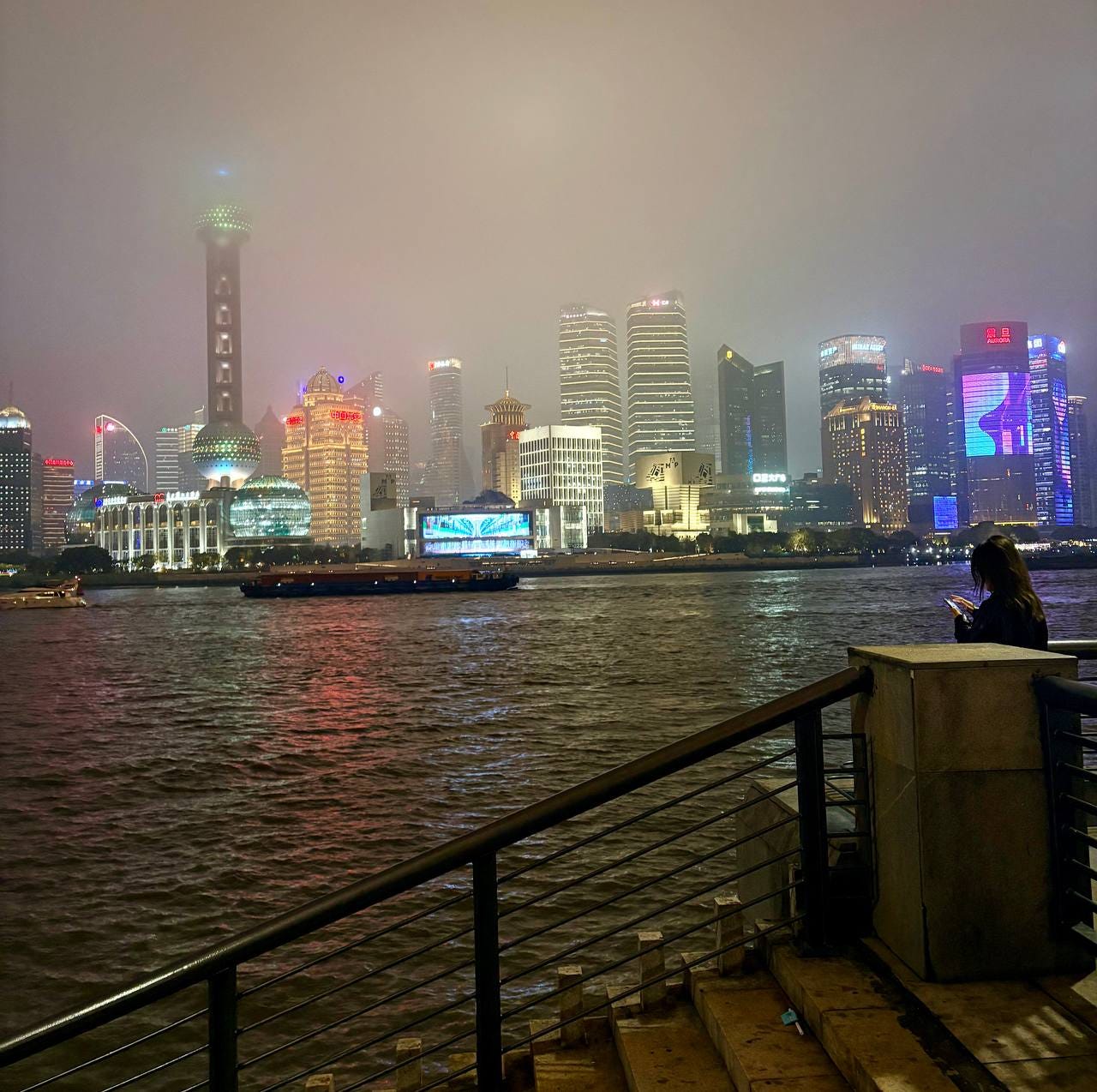
My first impressions of Shanghai was a combination of New York and London, as the Bund which looks towards super modern Pudong makes you feel like you are standing on the Thames, and the big bright lights of the Nanjing shopping street made me feel like I was in New York. I guess that is the biggest difference, that when we visited Beijing, it felt very Chinese. Shanghai was so diverse, including architecturally, that it made me want to learn more about its history. I must admit, my knowledge of Asian history is rudimentary at best. This 2006 archive piece actually does a great job of summarizing what makes Shanghai feel like such a mix of cultures, both architecturally, and somehow in the air — it felt lighter and less Chinese than Beijing. A museum on the history of Shanghai featured a new exhibit on Seoul, South Korea, and highlighted many of the similarities of the two economic powerhouse cities, and made direct references to “puppet Japanese” who occupied the city in 1937. I immediately remembered from our visit last year to Seoul learning about how long Korea had actually also been under Japanese occupation.


As we explored the tree-lined streets of the former French Concession (which really do look like they are somewhere in Paris, minus the clothes drying on the metal racks outside the windows), I kept thinking about what all this colonial history means for modern China today. And then I got my answer in the most unlikely of places. After purchasing numerous delicious iced coffees and pastries (Shanghai is the queen of aesthetic bakeries and coffee/tea/matcha shops, very much like Seoul) and wandering the shopping streets of the French Concession, we headed to a smaller market area and then to a new big outdoor “mall” which reminded me of Scottsdale, except the buildings were actually historical, and right next to this upscale mall, Xintiandi, was a museum to the first meeting of the Chinese communist party. The Memorial Hall of the First National Congress of the Communist Party of China, to be exact.
It was totally surreal to go from a delicious burger at Shake Shack (literally better than any I ever ate in America), luxury Korean skincare, and nearly every designer brand you can imagine to a modern museum with entry free of charge which is essentially like a very well done propaganda exhibit to the origins of the Chinese communist party. There were groups of Chinese visitors all wearing party flag pins on their jackets. There was another group who arrived and stopped at the entrance to all recite what sounded like a Chinese pledge of allegiance together in unison. This all right next to a mall which was a capitalist wet dream. My conclusion? Communism in China is not anything to do with communism, it is a unifying national idea replacement, and centers around an identity based upon a single national idea, and a strong sense of anti-imperialism, anti-colonialism. You read the history of Shanghai, look around at the wonders they have built over the past few decades alone, and understand of course why China sees its future as something only China should decide and be in control of. From what I could see, modern, authoritarian China is just as capitalistic as any society I have experienced.
The differences to the U.S., though, are stark. You don’t see homeless people. You don’t see drug addicts. I am not saying they do not exist. I am saying they have likely been removed from public sight. I did not ask any Chinese people on our trip how they felt because the longest interaction we had was on a subway when a sweet young woman offered one of my daughters one of her keychains from her backpack. When you go into restaurants or cafes, you very often order directly from a QR code menu, and you do not tip (it is culturally not expected and would be weird if no one else is). The element of small talk in a shop or cafe is simply not there, especially when you don’t speak the language. Everyone is exceptionally polite. I tried to attend a Chinese class this past fall and I failed miserably. I accepted there are some things beyond my brain capacity, and Chinese is one of them. I walked around in awe of them all, and barely managed to recognize a few words and characters from the hundreds we were taught.


My daughter asked to visit an English bookstore. I found one, officially titled, “foreign language bookstore of Shanghai”. I found a display of official books (see photo left), and there was censorship, but it was subtle. A stamp on the inside of the paperback novel that it had been approved for sale in China, and on one of the back pages, in a story which took place during the Vietnam war, a paragraph had been covered up in thick, white sticker which was difficult to remove from the page. My daughter discovered this paragraph contained derogatory words about communism. While in our hotel room, there were a few old films free of charge, one of which was Gone With the Wind. Traumatized by viewing it too young (another parenting fail of mine), they asked to rewatch the amputation scene, only to discover it had been cut out of the flim. These are tiny things, but reminders that a capitalist paradise can also co-exist with full control, or at least the illusion thereof, especially in a digital society.
AliPay, to be fair, knew my every move. It knew which taxis I took where, what I spent money on and where, and even which bank cards I used to pay for those transactions (you can add more than one, thankfully, as in the middle of the trip my eldest informed us his copy of my credit card had been stolen and I would have been stranded if not for a back-up Revolut card I added before the trip). In general, I didn’t have the impression anyone in China was annoyed by the endless swiping and scanning of QR codes. There are lots of employees everywhere you go but less so in customer-forward roles, more in fulfillment of orders. I thought a lot about a recent report I read or heard about China’s economy and the boost it could experience if it were to reduce the tax burden on the lowest earners, the backbone of its “gig economy”, the 200 million plus delivery drivers and the like, and how freeing up more disposable income for them could give the entire economy a GDP-boost.
I also thought a lot about the construction bust you read about, and as we took two long subway rides through semi-agricultural outskirts to reach the wild animal park where my daughter was insistent on feeding a red panda apples like she had seen on TikTok (incidentally, the Chinese are all on their phones on the subway and all watching the Chinese version, RedNote), I did see some groups of empty apartment blocks never finished. I read recently this creepy article about some burials of ashes (!) now taking place in some empty blocks due to lack of affordable cemetary plots. To be fair, we were almost entirely in the city center, so I personally did not see a lot of evidence of this overconstruction. What I did see on existing construction sites were huge mini-villages of accomdation for construction workers in containers, like you see in the reports from Dubai. Which means laborers are being brought to the site and then living there the entire time they are working. That is, I assume, how you transform a country’s infrastructure at lightenting speed.
I was left with the impression that everything opens early and works late, and the subways were crowded at all hours of the day. I felt like one has to hustle to survive, and everyone was busy hustling. It was in such sharp contrast to the apathy and lethargy and trapped-in-time-slow-decay (I really am grappling for words here) I experience in Vienna these days, especially in institutions. I wondered if China has an AMS or job center, and what the terms are. I know that high youth unemployment is still a problem despite the visual you have of economic activity all around you. There is a hustle — as you walk down the street and stick out like we did as three blondes, you are approached by people with little business cards asking if you want to buy counterfeit bags. I assume you are then taken to an alley around the corner.
Transportation and food are generally cheap if you translate the average prices in to Euros, but I am assuming that everyone in China is also earning a lot less. I actually caught myself thinking this morning on the u-bahn in Vienna that the people here look worse dressed and less well off, in the way that poverty and years of stress leaves lines on one’s face, than the Chinese I saw on the subway in Shanghai. The major hotels cost like any other major city in Europe, and the same I think is fair to say about non-food shopping. Our hotel was filled with both Chinese and western guests, and I suppose Disneyland was sold out in part due to a brief early April school holiday in China which coincided with our visit. Surely income inequality is rife in China’s major cities, too. China seems to already have a homegrown enormous “Amazon equivalent” company which is the answer to any consumer need or want in any category.
Everything I am writing are massive generalizations and I therefore perhaps hesitate to even go on. The last evening one of my kids turned on CCTV channel one, and it was exactly what I would have expected, perhaps even more so. Friday night family generational dramas with tears and emotion and main characters who work in courts as judges/prosecutors. Instead of commercials there were what felt like long, beautifully shot, modern infomercials about everything from China’s nature and agricultural wealth to the accomplishments of Chinese children in schools. At 10pm, the nightly news came on, and was, as expected, only about China and their own achievements, factories, economic news, etc. Remember, if you even want to use WhatsApp or Instagram, you need to use your VPN, and even with the VPN, some apps like TikTok were incredibly slow to load. Reaching different points of view is not impossible but it is a hassle.
China has created a world within a world. And most of the time, frankly, at least in Shanghai, it felt like the future. None of us wanted to fly home. My girls were downright emotional about not wanting to leave. I had not expected that.
p.s. briefly on who else is visiting China now — most of the non-Chinese visitors we noticed were speaking Russian. You do see/hear other Europeans, too, and some visitors from the Gulf states for obvious reasons. One morning we were buying subway tickets and I overheard a group of still-drunk-from-the-night-before young Russian men. I asked them gently if they needed help. They were as confused by the English screen as the Chinese. They were trying to get to the train station. I helped them to buy their tickets, and the most sober of the bunch thanked me and tried to apologise saying they ‘got an early start’ while the reality was, of course, they simply never stopped. It was somehow rather comical, this scene of lost, drunk Russians amidst a morning rushhour, it took me back to the early 2000s when many of them were just discovering foreign travel. But most of the Russians we saw were families and looked solidly middle class, not extravagantly wealthy. Important to remember geographically many Russian cities are closer to China than to Europe, plus no need to get a visa (China lifted the visa requirement in September of last year in large part to encourage more tourism from Russia).


This week I would also like to share with you this very moving, exceptionally researched long read by veteran war reporter C.J. Chivers who spent several months in Kyiv this winter:
How Russia Weaponized the Cold Ukrainian Winter (gift article)
I barely monitored the news out of the U.S. and Iran while we were in China. It was actually like escaping for a week. I thought a lot about what this moment might mean for China. Would they use this opportunity with the world distracted elsewhere to do something in Taiwan? This FT video below presents an interesting summary to China’s position as a net importer of oil but having diversified its energy sources and able to negotiate 1-on-1 with Iran to get its tankers through, as the analyst No. 3 observes (more on that bonkers story in a second).
Skimming through X the other day I came across this insane story about an investment research firm which sent an analyst directly to the Strait of Hormuz, armed with $15,000 cash, some nicotine pouches, and cigars, to try and figure out from the source what if anything was actually getting through. The full article is behind a paywall:

New York magazine also published an excellent summary here (if you give them your email you can read it for free).
I present, the TL;DR version, which is truly epic:
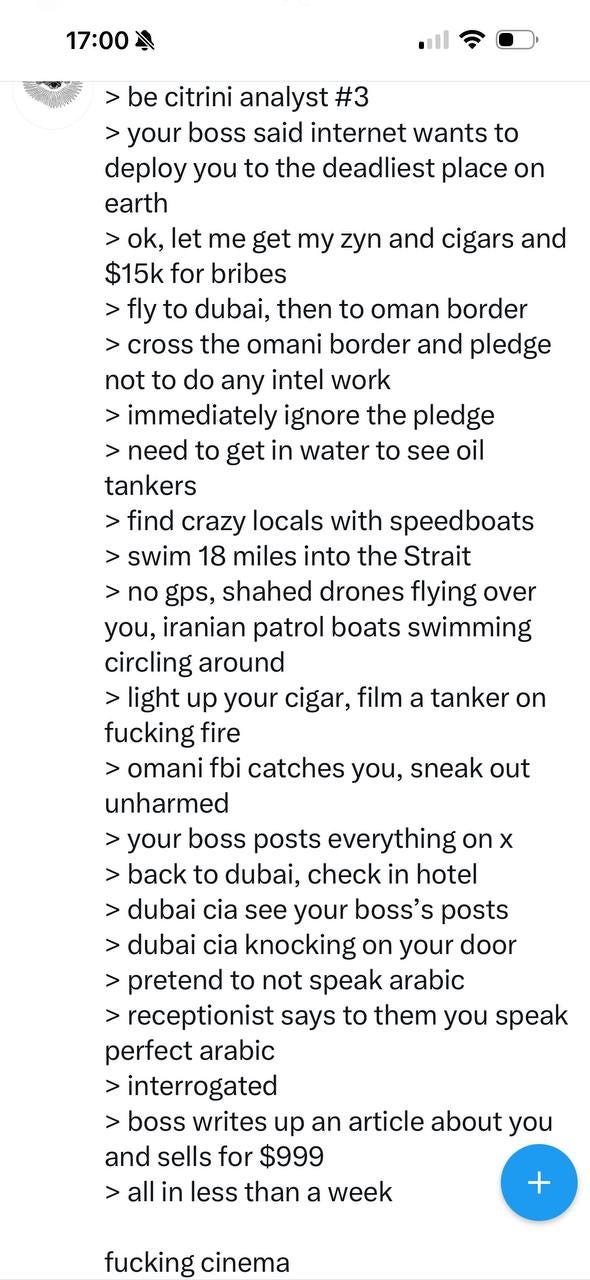
Bottom line: analyst No. 3 observed that some Chinese ships are getting through, which means China has made deals with Iran, and also that for now at least, the strait is not mined.
I found this discussion below to be highly timely and informative both on China and AI and on how things might develop with Iran. It is amazing to think that one Austrian developed a new tool so powerful it may now entirely redesign how companies use AI. The Chinese are calling it “lobster mania” refering to OpenClaw. Basically, unlike “chat” AI apps, OpenClaw actually peforms tasks rather than just asking questions.
I am really the last person who should be commenting on anything tech or AI, in that sense I am very old European (lol), but if anyone can adapt to this new future it is modern China because they are already living it. I thought a lot while we were there about how such rapid development was possible, on such a massive scale, and so quickly, and it soon becomes glaringly obvious that such changes could only have been possible under an authoritarian model — democracy and public debate do not lead to quick and efficient decision-making, as we see now in the struggling economies (and defense systems) of many old European countries. I wonder if in this new world the concepts of liberal and democracy and individual voices will become passe, obsolete, just like our brains and bodies, as AI and robots replace them. The biggest challenges will be how we as socities determine what rights every individual is entitled to, and how everyone can have a chance at making a living while not overly subsidizing one group at the expense of another. In many ways liberal democracy, at least the old European version, is already failing younger generations as pensioners will never vote to take a pay cut in the present in the name of future economic growth. People are generally selfish and will generally vote in their own self-interest. In some countries, like China, no one asks you to vote in the first place. And yet, in general, in the big cities, people look happy and pretty well off. I would argue more so than in what I saw in Germany just a few weeks ago. Actually if I stop to compare what I saw in Berlin and what I saw in Shanghai all within the span of a few weeks it is shocking. Truly.
As for my home country, I have left Trump out of all of this on purpose because reading the tea leaves is an exercise in futility, now more than ever, and the mood swings seem to grow worse by the hour. Vance has been campaigning with Orban this week which is just so lame, especially now that even the Hungarian people have decided a change of leadership is long overdue (I am being diplomatic with my words).
I wish I could say I think the war in the Middle East will all be over soon but really I don’t see how it can end soon. I think the new normal is a lot of geopolitical uncertainty and that is, frankly, bad for business for everyone. Well, except for those placing insider bets on what Trump is about to post on Truth Social. What a time to be alive. It feels like the rug has been pulled out from everything we were told to believe in but nothing has arrived yet to replace how we are supposed to see things and make sense of it all. I find myself questioning everything at the moment, and I am fairly certain I am not alone in this.
I have no idea what to tell the kids, and this kills me, slowly.
Thank you for reading, and sorry for the delay.
Fascinating insight into China - thanks :)
Grass is always greener.. reads incredibly naive to me, all the more surprising because you usually post (and link to) thoughtful things.