
Taking stock
This week I'm all over the place -- from drones and sanctions to trade with China. A selection of what I've been reading & listening to. Plus an update on Cards for Ukraine and a small request.

It has now been nearly four years since Russia invaded Ukraine, and now Ukrainians in my Telegram group are teaching me about life in Austria. Late last night, while normal people were celebrating Halloween (I would have loved to but I didn’t have friends in Vienna to celebrate with — please tell me I am not the only one who finds it harder to make new friends as the digits in your age increase), someone posted in my Telegram group the reminder I should have written. That November 1st is a public holiday, which means we now have two days in a row of closed stores, Saturday because of All Saints’ Day, and Sunday because Austria is fighting Sunday shopping the way (some) people stubbornly fight technological progress. So now imagine you came to Vienna for a weekend, and you discover that all the shops you wanted to visit will be closed all weekend. It makes no sense. It drives me crazy. It means even grocery stores are closed, except for a select few who are licensed to remain open. As I type this in a busy downtown Starbucks, I noticed a few of the chocolate stores selling crap to tourists have obvsiouly been licensed to be open on holidays like today. I keep waiting, a decade and counting, for this old European nation to start to understand the basics of economics and business, but I have now learned to stop holding my breath. Sometimes, I really do miss the American brand of capitalism. I miss the 24/7 economy I experienced living in Russia. I miss convenience and flexibility and not having to plan ahead.
But I digress (interestingly somewhat related — I am about halfway through a fascinating, if very cerebral, packed with facts, book which I shared with you in my past post about the history of Central Europe, which is so so telling as to why both Germanic countries insist on forcing everyone to speak German and still teaching Latin in high schools. If this feels like your kind of autumn reading, here is a link).
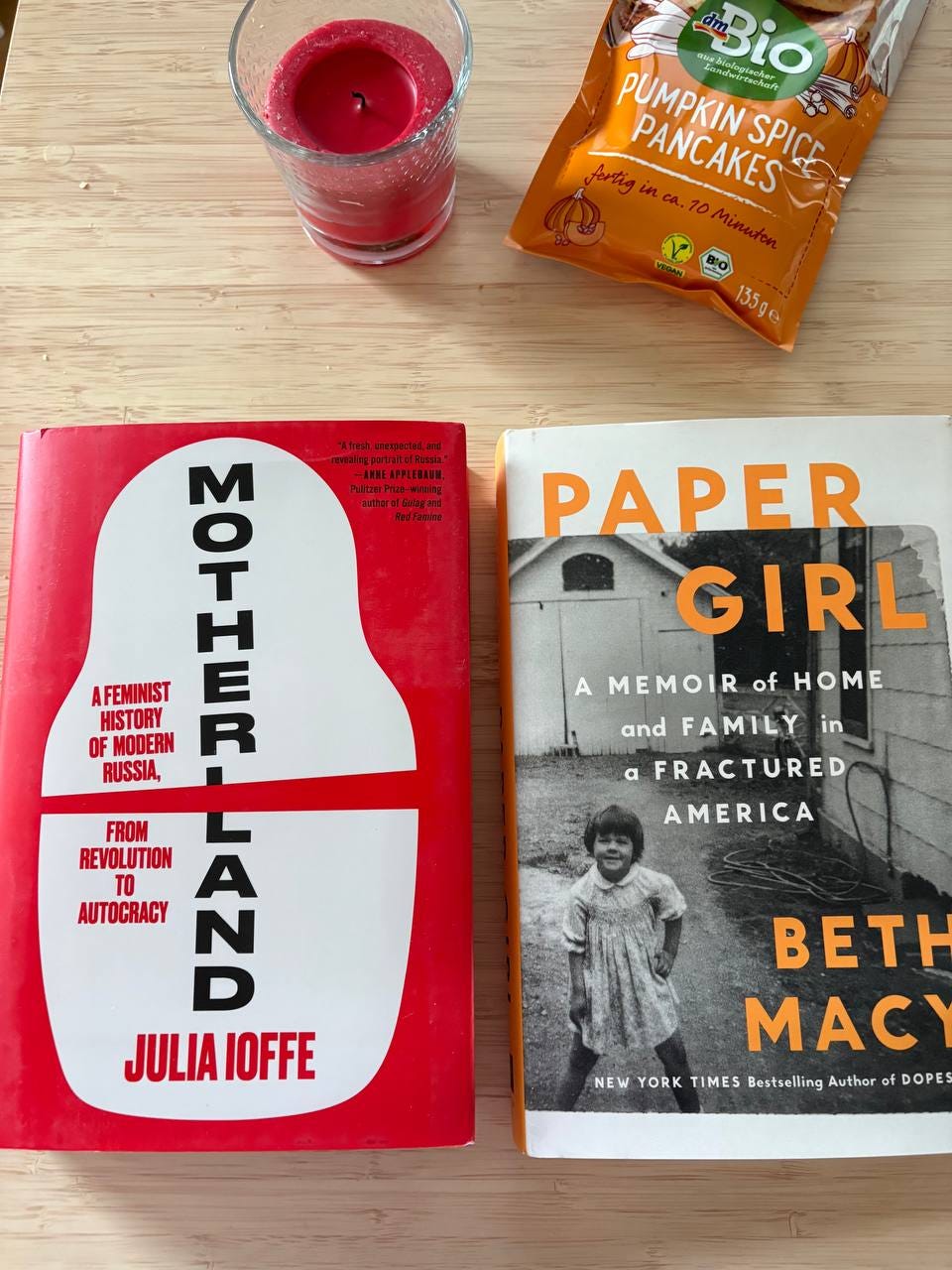
The postman brought me these two books this week which I could not wait to get my hands on, and ordered from the U.S. I expect both will not disappoint. As the weather turns colder and grayer, I am hoping I will be able to make more time to dive into books vs. mediocre television, which has been my guilty pleasure of late, but my brain is asking for more.
This week, my TikTok algorithm (no, it is not all silly dances, and if you aren’t on it yet, you are missing out on all sorts of content), started feeding me videos by media companies such as the New York Times and the Economist and FT, really informative clips with deep dive visuals into stories they have reported. I learned a lot from their reports on how drones have changed warfare on the ground in Ukraine. I had no idea that entire roads are being covered in fishnetting to prevent attacks on vehicles. These videos convey in a way words probably cannot the new reality on the ground, and what this changes about how the war is being fought. Which also probably means how all wars in the future will be fought. It is frightening, but I think important for those of us living in peace to understand the threat Ukraine is facing, and also what Ukraine is now capable of doing within Russia. The front line is one line, but it is not the only line.
The New York Times on the ground in Ukraine:

 Tiktok failed to load.
Enable 3rd party cookies or use another browser
The Economist on why NATO is struggling with Russian drones:
 Tiktok failed to load.
Enable 3rd party cookies or use another browser
Just this morning I read in the local Austrian news that the Berlin airport was closed for two hours due to “drones” in the area. This is an ongonig story which shows no signs of slowing down. Europe does not seem to have a real plan to deal with this kind of subtle Russian menance interferance in our civilian lives. This week, Lithuania closed its border to Belarus until the end of November over balloons smugglers use to deliver illegal cigarettes. But this is more than just smugglers, of course. This is a Russian ally figuring out yet another way to annoy a NATO member. If you read the local news in the Baltics, they seem to be particularly on high alert. A new highway also recently opened connecting Poland to the Baltic countries, which of course serves a security purpose as much as economic. I had completley forgotten that the border between Belarus and the Russian enclave of Kaliningrad is actulaly a tiny strip of land only 60km long, known as the Sulwalki Gap.
This all makes me nervous in a way you cannot really pinpoint. The older I get, the more, looking back, things seemed obvious in the way that the built-up over time, and then when events finally happen, logic tells us we should have all seen it coming, but we didn’t, because it is human nature to believe the future will be better than the past, the same way we ring in the new year each year fully expecting it to be an improvement. I am old enough now to recognize this is not always the case. My 2025, for example, has genuinely been worse than 2024, and with only two months left to go, I have little logical reason to believe a great turn of fate is just around the corner.
I understand why Ukrainians who have built new lives in Europe want to stay here, with no clear vision of what a future Ukraine will look like. I understand most Europeans are just focused on their daily lives and not thinking about what would happen should Russia decide it’s the right time to make a bigger move (for example, should China move on Taiwan, with the world distracted by events in Asia). I am still sitting in Europe myself and am at a loss as to what to advise my own kids, where is the best place to build your future life. I don’t think there is one right answer to that question, even for an individual. But I would say that I would not feel entirely comfortable living right now, as many Russians in exile are, including some of my own friends, in Riga. Just a feeling.
This week the Economist 1843 magazine published a fascinating long read into the new “elites” getting ahead in Putin’s wartime Russia. I also saw this week that Russian police in St. Petersburg arrested an 18 year-old young woman, a street performer who would announce spontaneous concerts online and then sing cover versions of famous songs by protest musicians. It is telling that even this, small crowds of teenagers on the cold, dark streets of St. Petersburg in autumn, expressing in a very tiny way their own criticism of the regime, was enough to spur arrests. This means the Russian government is still very much nervous about discent. CEPA also published this long read on Russia’s “war on teens” in which the FSB joins the cause. Clearly, those making decisions in the Kremlin understand the risk of “losing” the next generation. Hence all the growing restrictions on western social media, but you can’t fight VPNs and you can’t fight a simple desire to live in a country that is connected with the rest of the world, as opposed to having voluntarily chopped its own arm off in the process of trying to cripple its neighbor.
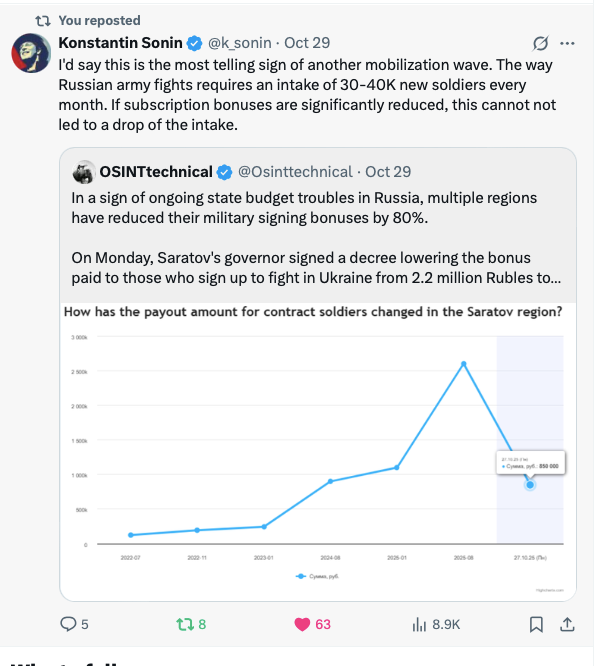
In the context of the new sanctions on Russian oil companies, I read this week that Russia is slashing the “sign on” bonuses in many regions awareded to men who volunteer for the army, which some believe might be a signal an actual mobilization will take place at some point in the future.
With regard to the new sanctions againt Lukoil and Rosneft, especally the potential impact secondary sanctions, I really enjoyed this podcast with Edward Fishman (who wrote an entire book about the power of U.S. sanctions), and found it to be the best explanation I have heard yet. Alexander Gabuev, who is asking the questions, is Russia’s leading expert on China, so it makes for an interesting discusson.
While following the media coverage out of the Asian economic summit, in which Trump and Xi reached some kind of “truce”, I noticed a few random things. First, Nvidia CEO eating fried chicken and drinking beer (all dressed in T-shirts, I kept thinking of the stylist group chat) with the CEOs of Samsung and Hyundai. I have a soft spot of curiousity for when extremely rich and powerful people cosply “normal”. Nvidia hit a market cap of $5 trillion earlier this week, making a new record in the history of all public company valuations. I still could not tell you, to my own embarrassment, what exactly they do.
With regard to the talks between the U.S. and China, Ian Bremmer calls it a “truce”. Seems like a pause button is being hit on both sides, but it doesn’t mean there is any kind of long-term agreement between the world’s largest two economies who of course see each other more as adversaries than anything else, sadly. I mean what kind of a world it could be if we viewed economc prosperity as not a zero-sum game.
For a deeper dive into the key issues and points of contention in U.S.-China trade relations, I recommend this conversation between two journalists embeded in China and covering the economy for some time. Don’t worry — the pod isn’t actually with Scott Galloway. I used to love listening to him and Kara Swisher, but lately the come across as too old, too wealthy, and too out of touch. I want to hear analysis and insights, but ramblings about their own lives. What is great and smart is to open their platforms to a new generation of young experts, and I very happily listen to those episodes.
On a side note — this was also a very good explainer on the recent election in Argentina, which I knew nothing about.
Turning back to Austria, we had a good week at Cards for Ukraine. I never expected to still be able to distribute grocery aid in 2025 (!), but here we are. Mario and I sent out over 300 €50 supermarket gift cards this week, and the lovely grocery photos have started to flood my inbox, along with words of gratitude in a multitude of languages. Very grateful this is still possible. Reading about the fiasco with SNAP benefits in the U.S. due to the government shutdown, I have been thinking about how something so simple as helping people buy groceries can really have a huge impact. I love the way our program works that we simply deliver a cash equivlent by mail, and leave the shopping to the person asking for help, thereby delivering a little bit of dignity in the process. I can only add that if you feel like making a charitable donation this holiday season, we promise to get those cards to Ukrainians in need. We buy the stamps and envelopes ourselves, and are zero overhead. We have now distributed over €300,000 in aid through our website alone, which is actually incredible. We have a waiting list of over 1,000 families, and it would be amazing to be able to work some of that off this holiday season. I also distribute directly to pensioners and moms who write to me.


In closing, I would like to ask for your feedback. This Substack started as a more frequent news blog, turned into a diary of my volunteer efforts, and now I have steered into a weekly look around the world, or at least the world that I find myself interested in. But I would like to build my readership, and see if it might be possible to monetize some of this, if I were to spend more time and write more frequently with a bit more structure (my weakness, I know!). What would be really helpful to me as a writer would be to know what you all like reading. Do you like my news analysis, or do you prefer more the first-person stories I have shared on here? Which country are you reading from, and why do you find my views valuable? I have always struggled, my whole life in fact, with fitting in any box, whether it be “American in Europe” or “Russia watcher” or now “volunteer”, but it would be super helpful for me to know who is reading me, what you like (and don’t!), and how you think I might improve Weight of the World to reach a wider audience. Thank you in advance!
p.s. I also recently saw that Substack offers its writers the opportunity to embed podcasts here and I was thinking HOW FUN that might be. To interview interesting guests and share those conversations.
Dear Tanja, I am (you probably know) also living in Vienna, and started reading you as I admire the voluntary work you are doing to help people from Ukraine, it is very interesting to read your interviews with Ukraineans. But I also love your overview and personal analysis of the world news , which I otherwise would not have known. I appreciate that you are a kind of world citizen, with connections to USA, people in Russia, Austria, probably Balkan, not writing from one angle, but from a world view. Also loving your personal stories about your travelling to other countries and personal experience. I think it is the mix that does it, I never know what I will find in your writing next. By the way if you'll have too many of these interesting books some time at home after reading them, I will happily buy them from you 😀
Hi Tanja,
I really value the work you put into writing Weight of the World. It is filled of a lot of information that I would not otherwise know how to access. After Russia invaded Ukraine I wanted to understand more about the history and the impact on people's lives. Your blog provides this as well as lots more information about world politics and interesting books that you share. I love your style, you have a clear, interesting and critical voice that more people need to hear. Thank you and please keep writing.