
"Thanks, chat...
... love how you just didn't give me an answer!" This week I have been thinking about AI, while pondering what Europe stands for.

Just as I was about to hit publish, one of my teenagers shouted the phrase above while staring with frustration into her laptop.
This week I observed (you will note I am choosing my words carefully) a fascinating scene. I watched a teenager of early high school years strategically enter instructions into an AI website we are all talking about. I watched as it generated feedback, in this case, points to use to make arguments both pro and con for a given topic. I then observed as this teenager formatted and printed this arguments out in the exact same font and size which is used in the dictionary students are allowed to take into the exam room, and then cut and pasted these arguments into blank spaces in said dictionary. In total, it was a lesson in online research: correctly formulating a quesion and deriving answers using pubicly available infomation, as well as formatting and ingenuity. It was not an exercise in simply copying a text one does not understand because one did not write it. I was actually duely impressed by the whole endeavor. I imagine these skills might actually come in handy in a future job, provided one can still string the appropriate words together in the working language without having to ask a computer to do that part, too.
This week, New York magazine ran a provocatively-titled story, “Everyone is cheating their way through college”, essentially making it seem (and this may be the case in many places, I cannot judge from a distance) that college students are no longer doing work on their own and instead using AI to do, well, everything. Here is one little excerpt which I stumbled upon on X:
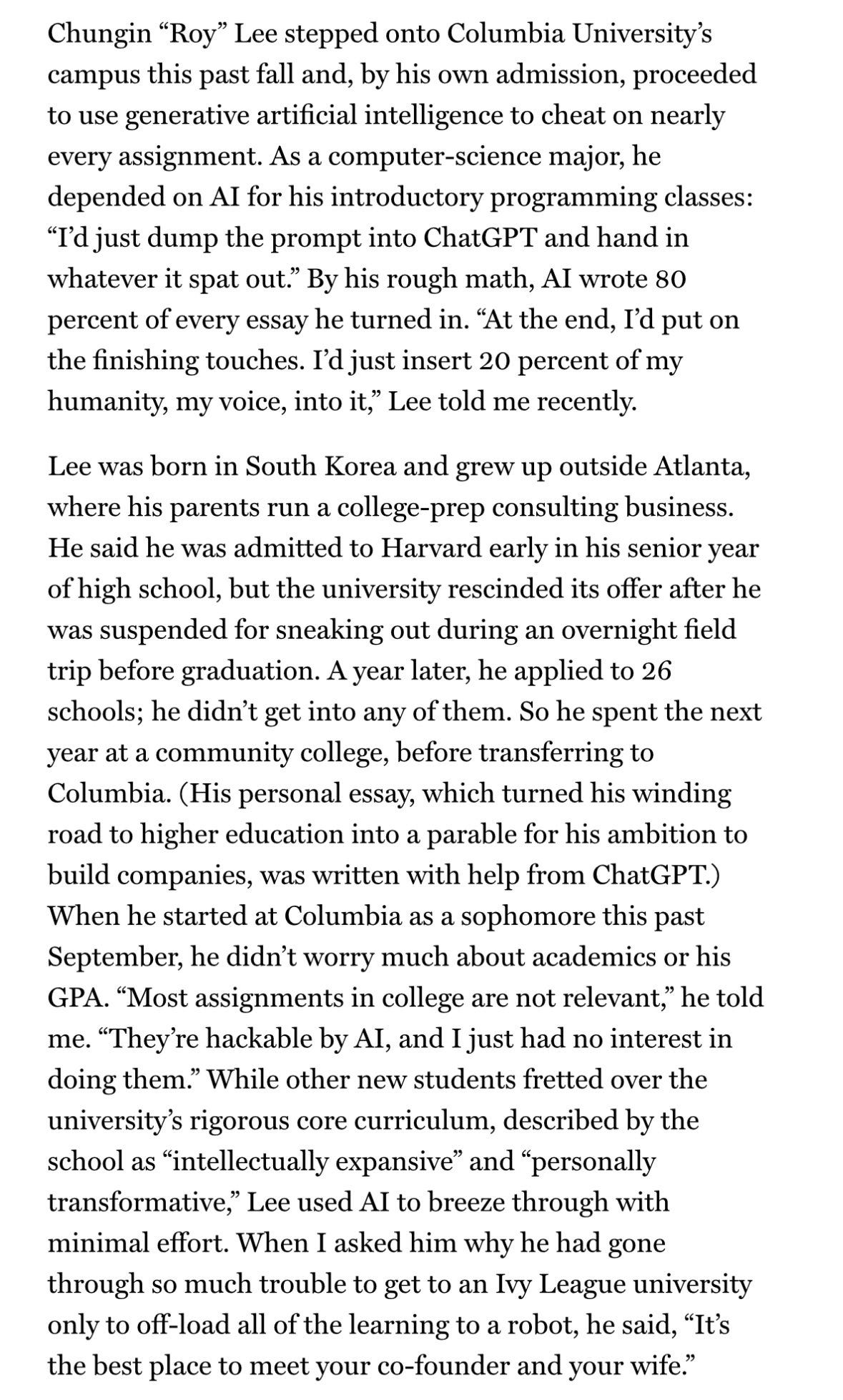
The excerpt speaks for itself, doesn’t it? Adding in the 20% of “humanity” required, going to college not to learn anything but instead to meet humans who could be useful in his future professional and personal lives. I wonder how this will unfold, if colleges will shift to assigning more tasks which require an actual human to solve them, or if adaptation of AI will become the new norm, much as we see students in schools learning to use it here and there were it makes their lives easier. My hunch is AI is more likely to be used in situations where the bar is low and the “humanity” of the grading process is limited. I can imagine it will become the norm in giant universities where a TA is likely grading your paper to begin with, while professors at the top universities will still be able to to spot AI-written work. It does have a certain tone to it. Just like we humans can easily identify AI-generated photos in media and online dating. They have a look to them. You see immedidately that the images are AI-generated.
Interestingly, an article also was published in The Atlantic this week which describes the rough job market for new college grads in the U.S. and how they are essentially, in many respects, competing with AI for jobs now. If you scroll through TikTok, you will come across videos from recent grads from insitutions as prestigous as Yale, lamenting that they have not been able to find a job upon graduation.
“…today’s college graduates are entering an economy that is relatively worse for young college grads than any month on record, going back at least four decades.”
In Europe, you have students studying for much longer, also with unclear job prospects. I came across a TikTok this week stunned that the way medical school works now in Italy (and not just in Italy), is that everyone is allowed into the first semester and then those who do not pass a threshold are simply kicked out the program, rather than making the entrance competitive in the first place. The wasted year of those students’ lifetimes and the resources used to teach them during that first year? An afterthought.
I think higher education, much like school, has been both diluted (these days in the U.S. basically anyone can go to college, and a Bachelor’s degree is seen as a prerequisite to almost everything, sort of diluting what it used to stand for in generations when not everyone studied beyond high school), and I start to question the relevance of well, a lot of it. This week I accompanied a 17 year-old Ukrainian who could not yet speak German to ask about studying at the University of Vienna. As I looked for the admissions office, I passed more than one homeless person sleeping at the tables in the corridors. When we asked about the requirements for entry, it was explained he would need to present his Ukrainian high school diploma (which unlike Austria is only 11 grades), and A2 German. The deadline for presenting the A2 German certificate, we were told, is early June to apply for the fall semester. “No problem,” the boy said confidently, yet wasn’t able to string together a sentence or two to speak on his own with the admissions officer. I wondered how he imagned actually doing any learning of any sigificance in a language he didn’t yet understand. I really wondered to myself, what is the point? Is the point to acquire a piece of paper everyone thinks you need? But do you really need it at all?
I look at what schools in Europe teach. Here in Austria, high school students have half a dozen foreign languages, plus all the other usual suspects. I am parent to one child who is literally drowning in the weight of the busy work, struggling to understand the concepts for which there are not enough hours in the day if you are one of those not born with a naturally-academic brain which doesn’t absorb concepts the first time they are explained. For a kid like her, I wish I could guide her to AI which would make her life easier, but she still has to sit exams herself. She needs a piece of paper to graduate onto adult life, but frankly none of what she is learning will she ever use as an adult. Neither the higher math which gives her so many sleepless nights, neither the Latin which gives her nightmares. Europe is still, in many countries (not all, Scandinavia being a notable exception), teaching as if we are still in the 19th or early 20th century. What of these skills teenagers are supposed to take with them in their future careers in the 21st century is a mystery to me. I can see the value in foreign languages. I can see the value in understanding history. I can see the value in basic (key word being basic) maths. But the rest? Totally up for debate. There seems to be a huge disconnect between what we ask of kids (same as we have for generations), and what they will be asked to do when they go out into the world.
In the context of AI, one should probably ask oneself, what can AI not do? AI may one day replace many of our lawyers, it may even replace some of our doctors, but it probably will not be fixing broken toilets, performing aesthetically pleasing manicures, and cooking up delicious meals in kitchens. Services, of all kinds, will remain distinctly human. One of my kids came home completely exhausted after working an eight-hour trial shift at a cafe yesterday. That day is now ingrained in her brain. She worked entirely with her hands and feet, phone put away in her locker. So ironically, it is the perhaps the more academically inclined graduates who will have to ask themselves, will my profession become obsolete in the future? Creativity, I would imagine, is also irreplacable. AI can write texts, or poems, or even song lyrics, but will we as humans want to consume them, without that intangible ingredient so hard to describe but what makes things distinctly unique and human?
I was inside a government office this week. Working class district of Vienna. A Ukrainian needed to make an official declaration that she had lost her government-issued ID. Average staff age was under 30, nearly all women. They worked as slow as molasses, even at the 8am opening time. We had to pay €2.10 for the piece of paper, and this required a walk up two flights of stairs to the cashier, where we found an older woman actually perusing a real catalogue of clothing, like the paper ones which looked like magazines and used to arrive in the mail in the 1980s. She quickly shoved it into a drawer as we saw her approaching. Nearly every job inside this buildling, with the exception of the janitorial staff, could be more efficiently replaced by an ipad. And yet, Europe (and not just) holds onto these jobs from which one cannot really be fired because they create employment. But you cannot tell me in all seriuosness that Gen Z dreams of rote data entry half-day work. It was mind-boggling to observe. These were young people doing the kind of work which hasn’t changed since the 1970s (with the exception of the introduction of computers and printers). Surely this could not be the future of Europe? If it is, I don’t see a future.
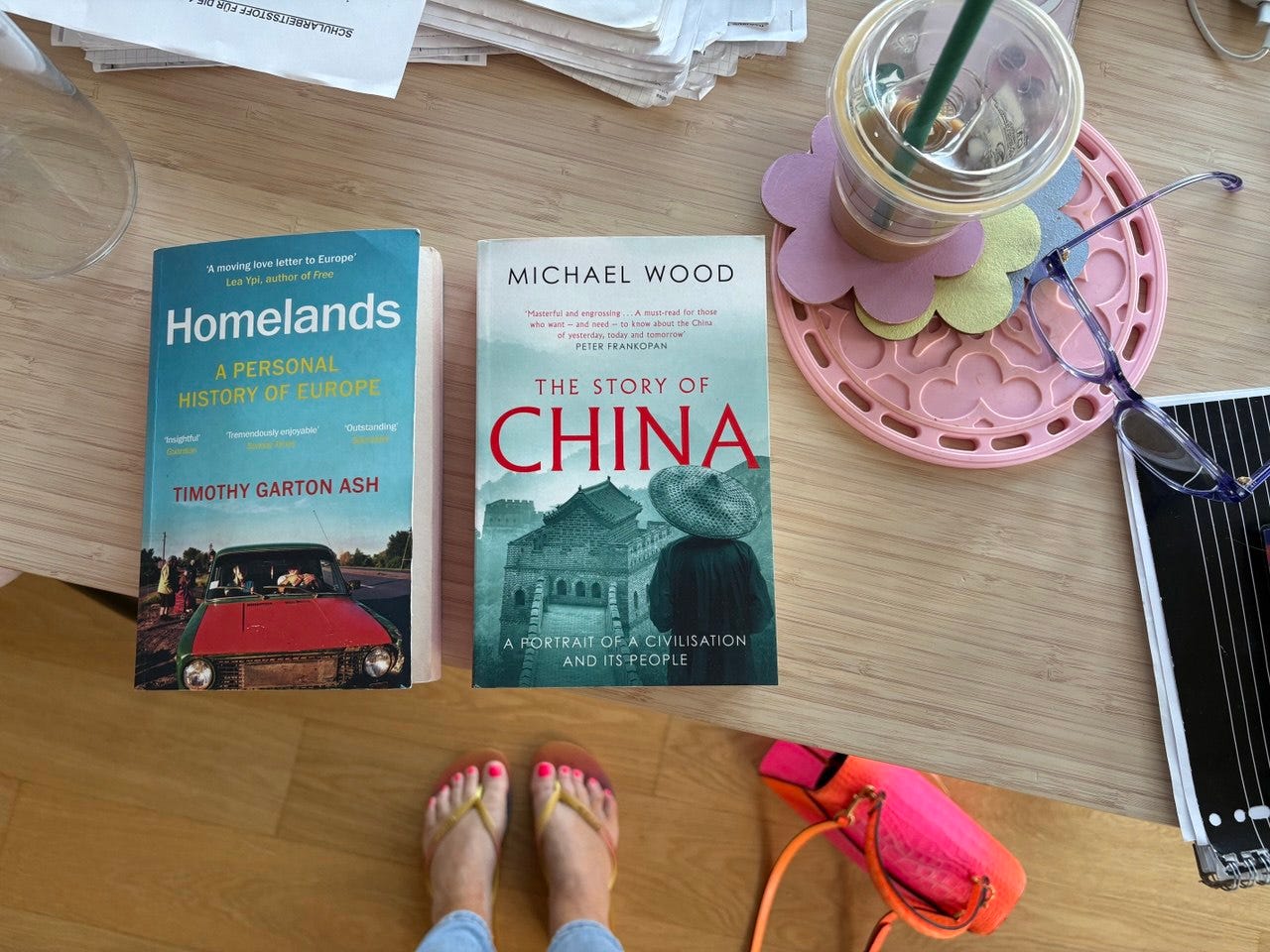
This week I have been enjoying Homelands, a look back at this European century by a British journalist who lived and worked amongst the transitions, beginning and not limited to East Germany and Poland during the 1980s. I really struggle with both defining Europe and understanding what Europe sees as its future, perhaps because I am not European. This book is really helpful in putting it all in context, and showing the more-or-less lasting peace which was achieved in such a relatively short period of time. Up next on my reading list is The Story of China. I felt acutely aware of the gaps in my (lack of) knowledge of Chinese history on our recent trip, and I would like to rectify a bit of that. I find myself googling “Shanghai” and Chinese language classes. As my eldest (back briefly from the U.S.) joked, “you have a fascination with for authoritarian countries”. Perhaps there is some truth to that.
Here in Europe, there have been important elections and political movements which I have barely touched on. There will be a run-off election in Romania next weekend in which a hard right nationalist “Eurosceptic” won the first round in the presidential election and is running against Bucharest’s pro-EU mayor.
“Simion, 38, opposes military aid to Ukraine, is critical of the EU leadership and says he is aligned with U.S. President Donald Trump's Make America Great Again movement.
Analysts have said a Simion victory could isolate Romania, erode private investment and destabilise NATO's eastern flank, where Bucharest plays a key role in providing logistical support to Ukraine as it fights a three-year-old Russian invasion.”
Poland will also be heading to the polls next weekend. This is an interesting 10-minute video report about the choices Polish voters face: pro-EU liberals vs. nationalists concerned with immigration. Poland has also been vocal about accusing Russia of trying to interfere in the upcoming elections.
“Poland says its role as a hub for aid to Ukraine has made it a target for Russian sabotage, cyberattacks and disinformation, and it has been on high alert for interference, especially after Romania cancelled a presidential election in December due to alleged Russian meddling.”
Timothy Snyder published on his Substack an interesting contribution from a Serbian academic about the wave of protests in his own country. I wish more western academics would do this, making space on their widely-read platforms for experts from their own countries to explain to the rest of us, in plain English, what they believe is happening and why it is important.

This excerpt, in particular, really beautifully describes Vučić & co’s balancing act which isn’t really all that surprising, given the tightrope Tito himself walked between east and west, rather skillfully and to his own benefit for many years, until he and the country, fell off.
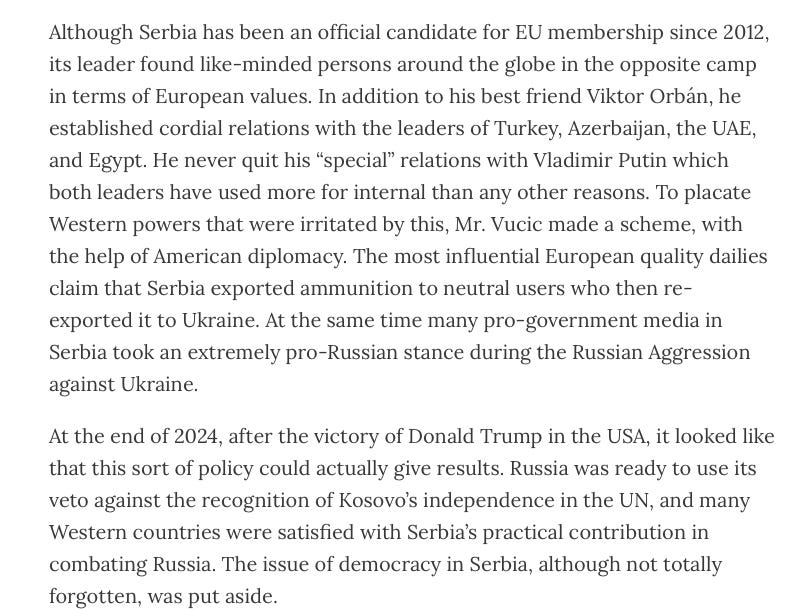
The issue of democracy. I ask myself nearly every day how much this means to voters anymore. How much does voting mean to citizens? I look at the economic progress in non-democracies such as China have made in recent decades, and ask, wouldn’t most people give up their votes if it meant for a better life in terms of economics for themselves and their loved ones? I think we in the west have a tendency to take as a god-given that everyone agrees liberal democracies are the best form of governance for our modern societies. I have a feeling, though, that if you ask people, especially younger generations struggling with finding gainful employment after years of eduation, and rising costs of living, that perhaps voting for elected representatives would not be top on their lists. Perhaps.
Yesterday, Putin held his annual parade on Red Square commemorating 80th anniversaroy of the the Soviet victory (because this is what it has morphed into, without any “Allies” at his side) over Nazi Germany on May 9 according to the Russian calendar. The leaders of China, Brazil, Serbia and Slovakia were all in attendance. So the rumors of Fico and Vučić calling in “sick” proved untrue. Europe isn’t, therefore, united in snubbing Putin. The Baltic states reportedly shut down their airspace, making arrivals in Moscow even more complicated, but this did not deter these leaders from showing up.
Ukraine now celebrates this anniversary on May 8, and the leaders of France, UK, Poland and Germany all gathered in Kyiv on Saturday May 10 in a show of support for Ukraine and Zelensky. There is now a very real question if face-to-face peace talks could begin this week. I remain skeptical, but I hope I am wrong. I still hear terrible stories out of Ukraine about the lengths the army is going to to fill its ranks. A woman told me recently about a cashier at a local grocery store in Kyiv. An ordinary woman working an ordinary job. Her husband, aged 50, has a disability which disqualifies him from military service. And yet recruitment officers grabbed him off a Kyiv street, took him into the military enlistment office, and held him for ten days demanding a payment (this is all illegal, of course, yet you hear these stories often) of $15,000 not to be drafted. He told his wife he would sit it out. They do not have this kind of money, and he thought he could call their bluff. It worked. Ten days later, he was simply released. But stories like this make one wonder: how much longer can Ukraine really put up a fight for? Assuming, of course, the determining factor is manpower, rather than say drones, which Ukraine has become a world-expert in producing. Sanctions do bite Russia, but not enough to make it stop waging a war it still sees itself as winning in increments. This is an interesting long-read on the real impact of economic sanctions against Russia.
Here in Austria, Ukrainians are concerned with two issues: their health insurance is about to run out at the end of May 2025 if the government does not renew it, and child benefit payments may not be renewed after October 2025, as they were an exception passed by a government which then included the Green party in the summer of 2022. We don’t have specific details, yet, but it sounds as if there is talk about pushing more Ukrainians into official employment in Austria by tying such benefits to employment. The healthcare situation in particular will be a big drama if the state health insurance cards suddenly stop working. I hope this is yet another example of bureacracy waiting until the very last minute to hit renew. But it would not surprise me if the rug is pulled out on some people, namely those Ukrainians neither officially employed nor receving basic care payments (many elderly fall into this second category). More and more Ukrainians who see their futures year (unsurprisingly, these are often mothers of teenage boys) are scrambling to find work and apply for RWR+ permanent residency cards once they have worked for a year. These labor permits have caveats attached to them, and this week I was even called into a school where a boy had “faked” (e.g. photoshopped) his report card to improve his German grade and then his mother made the fateful error of sending this altered document to the federal government. Now she has a permit, and he doesn’t. Instead, a policeman now has to report the whole incident, but assured the family it would not be more than a “black eye”. I sort of sat there, stunned by the entire situation.
In addition to the book I recommended above, I highly recommend the film Conclave which is timely as ever given recent events. Even if you are not a Catholic and not remotely interested in how a new pope is elected, I think you will find this stunning film still draws you in.
I also really enjoyed this conversation with the female founder of Bumble, Whitney Wolfe, who has since returned to the dating platform she founded to try and give it a second chance at success. Frankly, it sounds like uphill work. This conversation reiterates there are some things technology and AI cannot do (thankfully), as the younger generations rejecting “the apps” are arguing.
Finally this week I would like to conclude with a personal request. I started writing this Substack as an outlet to share views, exchange ideas, and recommend reading in longer form than Twitter then allowed us to do. When the war in Ukraine began, much of my writing shifted naturally to this topic as my volunteer work consumed me for a time here in Austria. More recently, I have been writing on a range of what I would call “trans-Atlantic” topics, sharing my perspective as one Russian-speaking American living in Europe for decades. My goal was always to make my blog free of charge to read, but of course paid subscriptions help me to cover some of my own costs. I try to write at least once a week, usually on weekends. I think some of my core readership was reading me for my writings about Ukrainian refugees here in Europe, and now that is not my only topic, my readership (especially paid subscriptions) has naturally dropped off a bit. I never thought to ask because as I said, my primary goal was (and is!) to make this material accessible for anyone who finds value in it. But if you do enjoy my writing and can afford it, I would be grateful if you might consider subscribing. Many thanks in advance!
I would also truly welcome feedback about what you would like me to focus more or less on. I usually go entirely off my gut feeling, e.g. what I have been thinking about this week, and very often, like today, it is a stream of consciousness. But I am very open to giving this more structure, should that be helpful to my readers.
Happy Mother’s Day to all of you, too! My morning began with making a breakfast spread for five (three children plus one sleepover). It was nice. For once I wasn’t complaining about being in the kitchen. I know those mornings will not be forever.
Seeing as you asked: the attributes I value from your blog are these: 1) Your reporting on the plight of Ukrainians in Austria; 2) The perspective of an American in Europe (as someone who left the UK for the USA, I know that sometimes it takes an outsider to point out some things invisible to natives), and 3) your truly excellent selections of what to read/watch/listen to. I totally understand that you cannot sacrifice your whole life to #1 and this has to taper off. But I would continue reading and subscribing for 2 and 3. Indeed, it was your uncanny ability to find the best reporting after Feb ‘24 that was the initial draw, and I still find your recommendations compelling.
Unrelated: I also don’t know much Chinese history but I found Frank Dikötter’s books on 20th C Chinese history eye-opening. If you think Stalin was bad…