
Two Swans
Some thoughts on Trump's visit to Beijing, the war in Ukraine (and now in Moscow), a few recommendations, and a sad update from Vienna where Eurovision is now (finally) over.

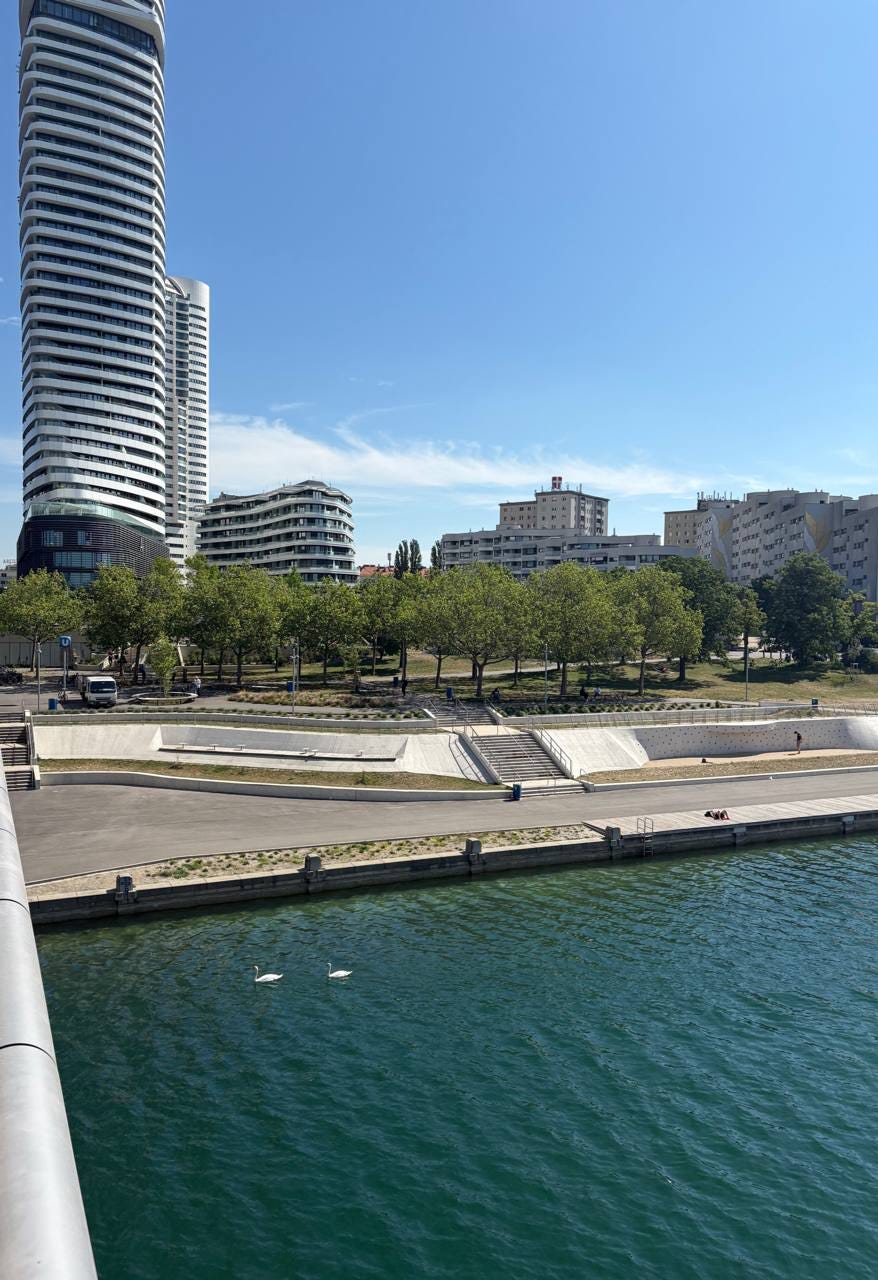
Having visited China twice in the past two years (and never prior), I observed Trump’s trip to Beijing with perhaps more interest than usual. I was fascinated by the pomp and circumstance, as well as the subtle trolling which the Chinese seem to be experts at. The rows of schoolchildren jumping up and down waving flags and flowers, all wearing coordinated shades of pastel, waving American and Chinese flags. Trump must have loved that, it was something out of a North Korean playbook. Communist adoration-light, if you will.
But by the end of the trip, Trump was placed in a chair next to Xi whose cushion was notably lower and softer, making the images produced mirror the sentiment, namely, that the visit marks the end of an American era, a metaphor for the huge shifts in the balance of power between the world’s two most powerful nations in recent decades, a shift that feels even more accelerated in recent years.
As I have said before, I am no China expert, but I did listen to a very interesting podcast this week with Rush Doshi, a former advisor to the Biden White House who is now a professor at Georgetown, and if you have 45 minutes or so, it is well worth your time to better understand what each country brings to the negotiating table and what it hopes to achieve.
How Trump Increased China’s Global Power
The very brief version of the arguments presented sounds something like this:
China acts as a mercantologist, selling far more of its own goods around the world than it imports from others. This trade surplus puts it in a tricky position in that it doesn’t need to buy as much as it sells, but it needs to maintain buyers for its exports. China used rare earth minerals, which it is basically the sole supplier of, as a form of blackmail when Trump played the tariff game last year (and subsequently backed down).
I learned a lot about AI chips, namely that they are nearly all produced in Taiwan, with the exception of a plant the Taiwanese have set up now in Arizona. Official China still views Taiwan as the “unfinished Chinese civil war”. The largest question looming over everything is will China in the future be willing to use force in Taiwan. There is already an official Chinese plan stating that their military must “be ready” by 2027 to do so (being ready vs. actually doing so being perhaps two different things). In listening to all this, I kept asking myself why the average American should care who is in charge of Taiwan, and aside from chip manufacturing, I couldn’t really come up with a clear answer, other than it has been for decades U.S. policy to sort of unofficially support the status quo, but it seems like under Trump’s second watch the Chinese smell weakness, perhaps rightly so.
I keep thinking about Xi in the context of Putin, which is perhaps not fair, but men of a certain age in positions of huge power, especially in authoritarian countries, do appear to think more about their legacies and future history books more than just about anything else. I thought back to the museums we visited in Shanghai talking about the communist revolution, and the venum which was reserved to describe the nationalists, and it would seem only logical that China would like to reclaim what it sees as unfinished business. Unfinished business which now controls nearly all productin of one of the most important pieces of the modern global economy.
The podcast also describes China’s more sinister roles: buying Iranian oil, supplying Chinese-made parts for Iranian drones. Putin is arriving in China for talks this week. Xi apparently even talked about the current period as the rise of the east, with the west in decline. American decline is seen as something dangerous: like a an angry drunk, America might just lash out in unpredictable ways. So China and the American voters hae that fear in common, ironically.
I was amused but not at all surprised by the grand meeting hall photos with not a single woman in sight amongst either delegation. Feels just about right, frankly, given the state of the world at the moment, wars everywhere you look, ordinary people feeling like their economic wellbeing is slipping between their fingers. This is what happens when you put all the men in charge. Women are the better sex at things like listening and empathy. Women might think about the future for a second, and not in the context of history books. But we as a species are not there yet. Ironically, ordinary women I think are now able to earn more than many of their male peers in many western nations, but in the highest circles, whether it be politics or business, the playing field was never fair, and it seems we are taking steps backwards. Not surprising, just disappointing. Sort of on brand for the dumpster fire around us.
While all this was happening in China, Russia took the opportunity to launch brutal attacks on Ukraine, which resulted in dozens of cilivians killed. Last night, Ukraine launched a drone attack on Moscow (yes, you read that correctly). It killed four people. My social media pages were filled with messages and videos from shocked Russians awakened in the middle of the night in their Moscow-suburb skyrises to the sounds of drones buzzing outside and, occasionally, exploding right next to their buildlings. The Ukrainians online, naturally, expressed zero sympathy, having themselves been living like that for four and a half years now and still counting.
I don’t know what peace Trump is actually talking about because just skimming the headines it certainly seems like both Russia and Ukraine are turning up the volume on each other. Both countries are now probably the leading producers of military drones. The FT apparently reported this week that Putin thinks he can take the rest of Donbass by fall, which when you look at what Russia has actually achieved on the ground in recent months seems highly unrealistic. But when I think about Ukrainian morale at the moment (low for a myriad of obvious reasons), I almost think anything is possible.
Russia and Ukraine appear to be in agreement on one thing at the moment — no prospect for substantive peace talks anytime soon. So two struggling economies will continue to slog it out, primarily with drones, and the civilians will pay the price, with Russians only now experiencing this new reality. Until last night, many Moscovites probably genuinley did not really think they were living in a war zone. Suddenly, with Ukraine’s incredible advances with its drones deep into Russian territory, anywhere in Russia can be potentially a war zone.
This week I saw the film Nuremberg in an English-language theater in Vienna. It was a unique experience in that the Hollywood decision to cast only English-speaking actors in roles as Germans was curious at best, comical at worst. But when you watch a film like that sitting in Vienna, it has a different impact, because you are surrounded by history when you walk outside (in this case, the theater is a stone’s throw from Judenplatz, or Jewish Square, with a memorial to all those murdered at the hands of the Nazi regime in the camps of the Holocaust). The next day, we were invited to a Bar Mitzvah here in Vienna, in a synagogue inside a business school built by a wealthy American who was once U.S. Ambassador to Austria, and the symbolism of all that this year 2026 was not lost on me either.
Step outside of my bubble, and Vienna was filled with its fair share of protests this weekend (mostly) against Israel’s participation in Eurovision which Austria was sort of begrudingly hosting this year (online accounts widely complained of lousy hosts and cheap sets) on account of their artist having won in 2025.
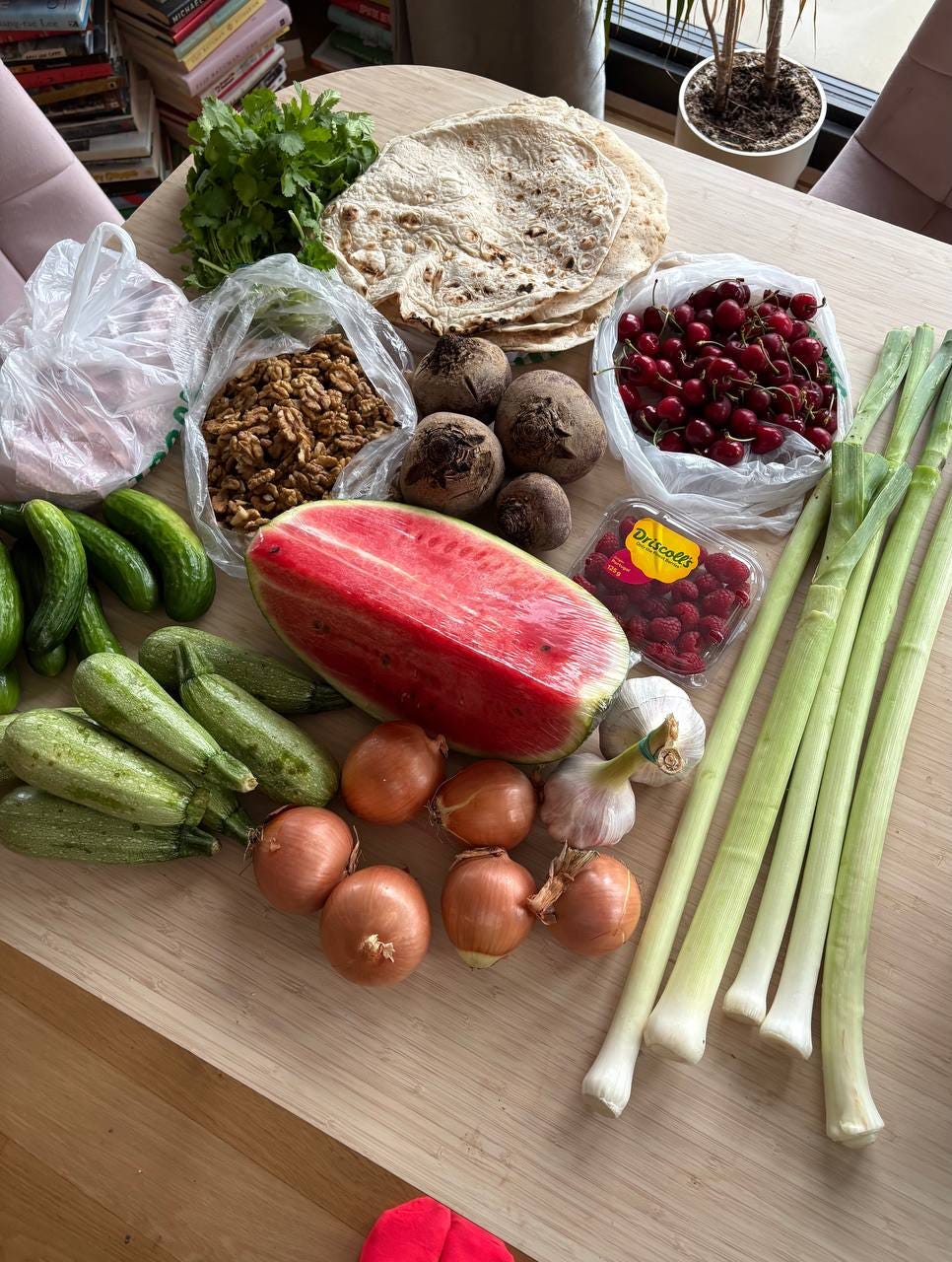
It was so rainy and cold, and Eurovision to me personally feels like a leftover from the pre-covid, pre-war era, when we had time to dedicate a whole weekend to campy music performances. Maybe I am just getting old, but I’ve lost interest. I instead took myself through our rainy, unseasonably cold streets (my teenager explained to me that climate change is also causing some of these wild temperature swings) to our local maket, where thankfully, one can still acquire super fresh produce at affordable prices. I take none of this for granted.
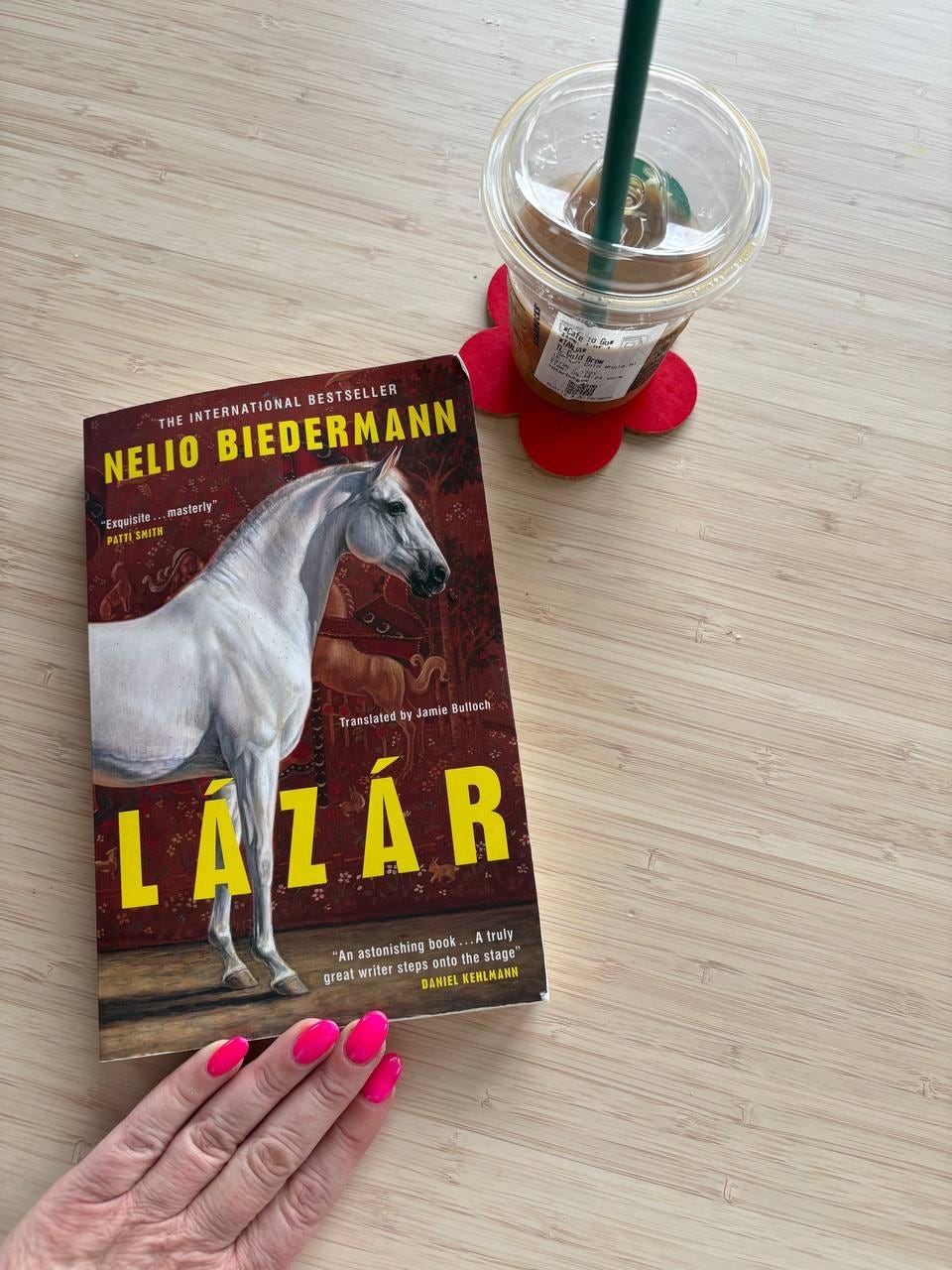
This past week has been difficult and a shock of sorts. I think I have mentioned before a Ukrainian woman who came to Vienna because of the war, I will call her V, and worked as a manicurist here. That is how I met her, the nails you will see in the photo below are her work. Last year, she was diagnosed with colon cancer, and on January 2, 2025, I received a phone call from the surgeon saying emergency surgery had been booked for a week later. At the time, they thought it was ovarian cancer, as the 15 cm (yes, you read that correctly) tumor appeared to the doctors as if it was growing from her right ovary. It was only when they operated, and performed a complete hysterectomy, in addition to removing the giant tumor, that they discovered the origin of the growth.
V then went through twelve gruelling rounds of chemo, trying to come back to work during the second weeks (the first weeks she was too ill from the chemo to leave her apartment). But by September, a miracle of Austrian healthcare had taken place: she was told the cancer was all gone and given the all clear. We all shed happy tears.
Unfortunately, a few months later, a terrible accident occurred. V was cleaning the windows in her new apartment, when she lost her balance and fell off the chair she had been standing on. Probably still frail from the chemo, she broke her right, working arm in several places, and V was unable to work for several months, and went back to Ukraine for some time to undergo physical therapy (Ukrainian hospitals are experts at this now) on her right arm after it had been operated on (a metal pin was placed in her wrist). This spring, it seemed, V was finally healthy again.
She gave me a manicure just a few weeks ago. She was coughing a bit, but the doctors had given her an inhaler, and told her to get a CT scan in May. No one, not a single doctor on her care team from what is considered to be a very good hospital in Vienna, said that she should come in for a CT scan at any point between September and May. Blood work showed increased cancer markers, which must have sounded the alarm bells. On May 12, I accompanied V as we walked into a room in the surgical ward (no idea why this task was left to the surgeons, it is as if the various departments play hot potato with the oncologists) where four stone-cold faces were waiting for us, and I immediately knew the news was bad. Both from the looks on their faces and from V’s terrible cough which now sounded like something awful, and she was struggling to catch her breath, walking slowly, complaining of pain in her side and back.
In short, the doctor explained, the cancer had come back, and basically everywhere: bones, liver, peretoneoum (abdominal cavity), spots in the lungs, lymph nodes. The team urged V to stay positive, but their faces reflected that even they themselves did not believe these words. Chemo was ordered for Friday.
I accompanied V on Friday. At this point she can barely walk, can barely breathe. I have to ask for a wheelchair as soon as we are dropped off by her boss who is a salon owner here and borrowed her boyfriend’s car to drive us to the hospital at 6:30am. We wait patiently for the team to set her up for in-patient chemo (standard, I am told, for the first round which lasts 48 hours). Finally, she is offered pain relief (until now, she had not received anything stronger than over-the-counter meds). Finally, the doctors order oxygen through her nose as the coughing is horrific and her oxygenation is dangerously low. I translate as much as I can, a team of white coats standing in the room. I try to make small talk until the drip is set up, and then I leave, bursting into tears in the elevator.
I know things can deteriorate quickly, but this is something unreal. V is younger than me. She has a grown daughter in Ukraine who is renewing her passport and will come as soon as she is issued a new one. She has a sister who lives with her in Vienna but picked this week to go away (I have already done away with any hiding of my feelings on that subject in the messges I leave her to update on V’s health).
A few weeks ago, I thought maybe I would try to fundraise for a bucket-list trip of sorts for V. Now I realize she may never get time for any of the list. Now I am hoping a doctor will take a look at her tomorrow and recommend hospice, so she doesn’t have to suffer alone at home. I am not family, I am simply a loyal client who happens to speak German. I feel the burden of this every time the phone rings and I try to translate as best I can for the medical staff over the speaker.
Money will not cure V, but she will face immediate trouble now paying rent, and eventually her family is going to need help with simple things like funeral costs. I don’t have the energy in me to set up a go fund me or something of the like, but I would like to be able to tell V I gathered some means of her covering some of her costs while she is in this situation which is honestly worse than anything I could have imagined. I had no idea it could deteriorate that quickly, or cancer could spread that agressively. My own mother lived more than eight years with stage IV breast cancer; I fear V has only weeks left. The doctors don’t say it outloud, but they refused to send her home today, acknowledging that she needs 24/7 oxygen, and I am grateful for every day they keep her in hospital. Tomorrow the pulmanologist will make a recommendation. I am trying to take each day at a time.
It is not easy. To stay calm and just translate the very painful words.
If you would like to help V, although she didn’t ask, she would never ask for a handout, I am sharing the original PayPal link I created for Cards for Ukraine, which has been inactive for sometime. Anything I receive this week I will hand to V directly, in Euros, in cash.
Thanks for reading. It helps me to share this very sad true story because it is also hard to carry it around with me. You hope you are doing the right thing, but the situation caught all of us totally by surprise. I don’t know who is to blame that the return of V’s cancer wasn’t caught earlier, and frankly, none of that matters now. I usually think a lot about the fragility of life, but now so more than ever. I will never understand why some people get punched, and punched, and punched again, while others carry on, scott free, seemingly, forever. For that reason perhaps I am not a religious person. But I do believe in doing the right thing, and that is what I am trying to do now, within my humble capabilities. Translating feels like the least I can do.
Hi readers! I just wanted to thank several of you SO MUCH for your generous donations to help V. She is now home from hospital and I will try to visit her this week. I know she will be incredibly thankful for the kindness of strangers. Thank you!